
Why a Clean Filter Won't Fix Weak August Airflow in Livingston Homes
Replacing a dirty air filter is the right first step, but it won't always restore your AC's performance. Here is why late-summer humidity creates hidden airflow blockages.

The Late-Summer Frustration: Fresh Filter, Weak Airflow
Your air conditioner is running nonstop, but when you hold your hand up to the vent, you can barely feel the air moving. You wonder why a clean filter won't fix weak August airflow in Livingston homes, especially after you just did the responsible thing and replaced the old, dusty one. You did everything right: you checked the thermostat, you bought a high-quality pleated filter, and you made sure all your room vents were open. Yet, the house is still hovering at an uncomfortable 80 degrees, and the system seems to be struggling to push any conditioned air into your living spaces.
This is one of the most common and frustrating scenarios homeowners face as summer drags on. We are conditioned to believe that restricted airflow always traces back to a clogged air filter. While swapping out a dirty filter is absolutely the vital first step in diagnosing airflow issues, it is rarely the final fix during the peak of the cooling season. When you replace a severely clogged filter, but the airflow remains weak, you are uncovering a deeper, hidden mechanical issue that has been quietly developing inside your air handler for months.
If you are dealing with this frustrating issue, our team is ready to evaluate your HVAC systems and restore your home's comfort.
During August and late-summer heat waves, intense ambient temperatures and extreme humidity act as a catalyst for a specific type of internal wear and tear. What you are experiencing is not a sudden breakdown, but rather the cumulative result of your system battling the East Texas climate day in and day out. To understand why your fresh filter isn't solving the problem, we have to look past the filter slot and dive into the dark, damp environment of your indoor air handler.
How East Texas Humidity Transforms Household Dust
To understand why late-summer airflow drops off so drastically, you have to understand how microscopic dust interacts with the local climate. No air filter catches 100% of airborne particulates. Even with a high-MERV filter installed, a tiny fraction of microscopic dust, pet dander, and household debris will inevitably bypass the filter media and enter the air handler. In a dry climate, this bypass dust remains loose and powdery. It might settle lightly on internal components, but it rarely causes severe mechanical restrictions.
However, Livingston and East Texas present a completely different environment. Our high relative humidity fundamentally changes the physical properties of household dust. During peak summer cooling, your air conditioner is pulling massive amounts of moisture out of your indoor air. This means the inside of your air handler is essentially a wet, humid cave. The evaporator coil is constantly sweating, and the surrounding metal surfaces are coated in condensation.
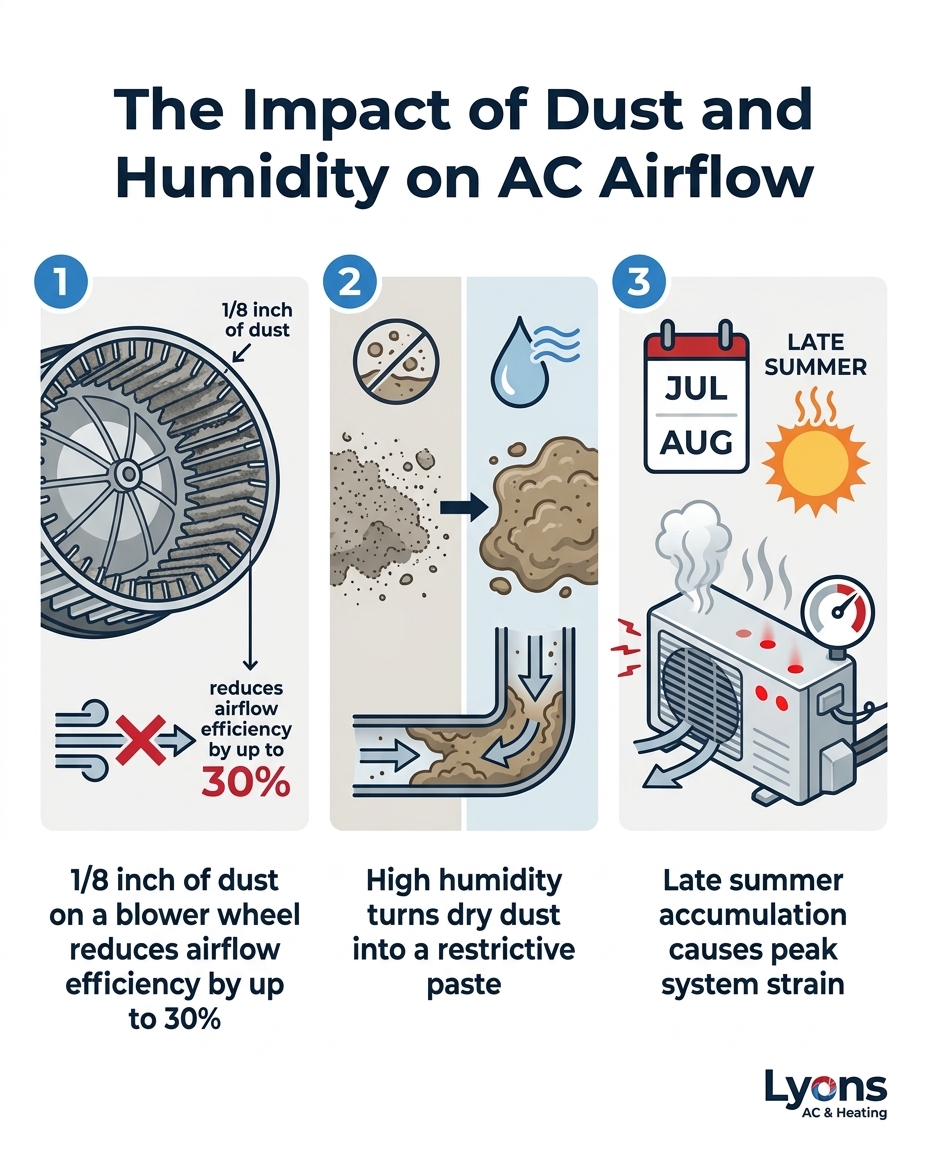
When dry bypass dust hits this wet environment, a physical and chemical reaction occurs. The moisture acts as a binding agent, turning loose, powdery dust into a thick, sticky paste. If you are concerned about the amount of particulate matter circulating through your system, improving your indoor air quality can help reduce the initial dust load, but it cannot reverse the sludge that has already formed.
The Difference Climate Makes on HVAC Wear:
• Dry / Arid — Moisture Load: Low — Dust Condition: Loose, powdery — Impact on System: Minimal buildup; easily blown through the system
• Moderate — Moisture Load: Variable — Dust Condition: Slightly damp — Impact on System: Slow accumulation over several years
• East Texas Summer — Moisture Load: Extreme — Dust Condition: Sticky, thick paste — Impact on System: Rapid sludge formation that heavily coats moving parts
This "dust paste" clings tenaciously to everything it touches. Unlike dry dust, which might eventually blow through the ductwork, this damp sludge bakes onto the metal components of your system. Understanding this regional humidity factor is crucial, which is why generic national maintenance advice often falls short for East Texas homeowners. Local expertise is required to understand exactly how this moisture load alters the wear and tear on your specific equipment.
The Impact of "Dust Paste" on Your HVAC Blower Wheel
The primary victim of this sticky sludge is your HVAC blower wheel. The blower wheel—often called a squirrel cage fan—is the mechanical heart of your air handler. It is a large, cylindrical component made up of dozens of small, cupped blades. Its sole job is to pull warm air from your return ducts, push it across the cold evaporator coil, and force the newly chilled air out through your supply vents.
For the blower wheel to work efficiently, those cupped blades must be perfectly clean so they can "grab" the air. When the East Texas dust paste enters the blower compartment, it begins to pack into the curves of these blades. Over time, the cupped blades fill up with hardened sludge, essentially turning a highly engineered fan into a smooth, heavy, ineffective cylinder.
According to Department of Energy data, even a 1/8th inch layer of dirt on a blower wheel can reduce airflow efficiency by up to 30%. When the blades are caked in mud, they simply slice through the air instead of pushing it. This is exactly why your vents feel weak even though the system is running.
The consequences of a caked blower wheel go far beyond just weak airflow. When this component is compromised, it triggers a chain reaction of mechanical stress:
• Increased amp draw: The added weight of the sludge forces the blower motor to work significantly harder to spin the wheel, drawing more electricity and driving up your utility bills.
• Motor overheating: Because the motor relies on the air it pushes to cool itself, reduced airflow means the motor runs hotter, greatly increasing the risk of premature failure.
• System shutdowns: If the motor overheats and trips internal safety switches, you might find that your AC fan stops working entirely, leaving you stranded in the heat.
No matter how clean your new air filter is, it cannot magically scrape this baked-on sludge off the blower wheel. The restriction is physical, mechanical, and deeply embedded inside the unit.
Thousands of Hours of Wear: The August Accumulation Effect
You might be asking yourself: "If this dust paste is the problem, why was my AC blowing strong, freezing cold air back in June?" The answer lies in the sheer volume of work your system has performed by the time late summer arrives.
By August and late-summer, an AC system in our region has typically run for thousands of hours. Think about the math: if your system runs for 12 to 14 hours a day during May, June, July, and August, you are looking at over 1,500 hours of continuous operation. During every single one of those hours, condensation is forming, microscopic dust is bypassing the filter, and the sludge on your blower wheel is getting thicker.
The Tipping Point of Mechanical Restriction
This accumulation is a progressive mechanical restriction, not a sudden, overnight failure. In early June, the blower wheel might have a thin film of dirt—not enough to noticeably restrict airflow. By July, the cupped blades are half-full, and your system is running longer cycles to cool the house. By the time August hits, with its continuous, unbroken heat waves maximizing the accumulation of condensate, the blades are completely packed flush with dirt.
This timeline completely validates your frustration. It makes perfect sense why you would assume a dirty filter is to blame, because the system degradation happened so slowly that you only noticed the severe airflow drop right around the time your filter was due for a change. Unfortunately, the filter is only the gatekeeper; the blower wheel is the engine, and by August, that engine is suffocating under a blanket of wet dust.
Beyond the Blower: Frozen Coils and Restricted Ductwork
While a heavily soiled HVAC blower wheel is the primary culprit for weak airflow that persists after a filter change, it often triggers secondary issues that further choke off your air supply. When the blower wheel cannot push enough warm indoor air over the cold evaporator coil, the entire refrigeration cycle falls out of balance.
The evaporator coil relies on a steady stream of warm return air to keep the refrigerant inside from dropping below freezing. When airflow is weak, the coil gets too cold. The condensation that normally drips safely into the drain pan begins to freeze directly onto the metal fins. Within hours, the entire coil can become encased in a solid block of ice. This ice acts as an impenetrable wall, blocking whatever weak airflow the struggling blower wheel was managing to produce.
Signs your weak airflow has escalated to a frozen coil:
• Warm air from vents: The system is running, but the air coming out feels room-temperature or slightly warm.
• Visible ice on refrigerant lines: The copper pipes running from your indoor unit to the outside condenser are covered in frost or thick ice.
• Excessive water pooling: When the system cycles off, the massive block of ice melts rapidly, often overwhelming the drain pan and causing water damage.
If you notice any of these symptoms, sliding a fresh filter into the slot will not thaw the ice or fix the underlying restriction. You will need professional air conditioning repair to safely diagnose the pressure issues, thaw the coil, and address the root cause.
Additionally, late summer is often when hidden ductwork issues reveal themselves. A disconnected duct run in the attic or a crushed return duct can perfectly mimic the symptoms of a dirty filter or a clogged blower wheel. Without professional diagnostic tools, it is nearly impossible to tell whether the air is being blocked at the wheel, frozen at the coil, or lost in the attic.
Why Internal Component Cleaning is Not a DIY Project
When homeowners learn that a dirty blower wheel is causing their airflow woes, the immediate temptation is to grab a screwdriver, open the air handler cabinet, and try to scrub the wheel clean. We strongly warn against attempting this. Internal component cleaning is absolutely not a DIY project, and attempting it can result in catastrophic damage to your system and serious personal injury.
First and foremost are the electrical hazards. Your air handler contains high-voltage wiring and large capacitors that store lethal amounts of electrical energy, even after the main power to the unit has been shut off at the breaker. Navigating these components without professional training is incredibly dangerous.
Secondly, the blower wheel itself is a highly sensitive, precision-balanced component. Much like the tires on your car, a blower wheel has tiny metal weights attached to specific blades to ensure it spins perfectly smoothly at high speeds. If you attempt to scrub or scrape the "dust paste" off the blades with a brush, you will inevitably clean it unevenly or accidentally knock off one of these balancing clips.
Even a microscopic imbalance will cause the heavy wheel to vibrate violently when it spins up. This vibration will quickly destroy the blower motor bearings, tear the mounting brackets out of the cabinet, and require a complete, expensive replacement of the entire blower assembly.
Proper removal of Livingston and East Texas "dust paste" requires a licensed professional. As a local authority in HVAC mechanics, our technicians know exactly how to safely discharge the electrical components, carefully extract the blower assembly without bending the delicate fins, and use specialized, coil-safe chemical cleaners to melt the sludge away evenly. We handle complex mechanical cleanings correctly the first time, protecting your equipment from accidental damage.
Restoring Peak Performance Before the Season Ends
You do not have to settle for a hot, uncomfortable home just because it is late in the season. Letting a struggling system limp into the fall is a recipe for a complete breakdown. When you schedule a professional cleaning, the results are immediate and dramatic.
Our professional process involves safely accessing the air handler, removing the heavily soiled HVAC blower wheel, and performing a deep chemical wash outside the home. Once the cupped blades are restored to their original, smooth condition, the wheel is carefully rebalanced and reinstalled. The moment the system turns back on, homeowners are often shocked by the sudden, powerful rush of cold air returning to their vents—restoring the cooling capacity they haven't felt since early June.
The best way to prevent this late-season sludge buildup from happening next year is through proactive care. Enrolling in a preventative maintenance plan ensures that your blower wheel, coils, and internal components are inspected and cleaned before the extreme heat arrives. Routine maintenance stops the heavy accumulation of dust paste in its tracks, ensuring your system pushes strong, efficient airflow from the first day of spring all the way through the final heat waves of late summer.
Frequently Asked Questions
Why is my AC blowing weak air but the filter is clean?
If your filter is clean but airflow is weak, the restriction is deeper inside the system. The most common culprits are a heavily soiled blower wheel, a frozen evaporator coil, or a failing blower motor that cannot spin at full capacity.
Can a dirty blower wheel cause low airflow?
Yes, a dirty blower wheel is one of the leading causes of low airflow. When dirt and sludge fill the cupped blades of the fan, the wheel loses its ability to grab and push air, severely restricting the amount of air that reaches your vents.
Why is my AC airflow so weak in the summer?
Summer weather causes your AC to run for longer cycles, pulling massive amounts of humidity out of the air. This moisture mixes with household dust inside the unit, creating a thick paste that coats moving parts and progressively chokes off airflow as the season goes on.
How does high humidity affect my AC blower wheel?
High humidity turns normal, dry dust into a sticky, wet sludge. Instead of blowing through the system, this damp sludge bakes onto the blower wheel blades, adding heavy weight to the motor and destroying the fan's aerodynamic efficiency.
What happens if I ignore weak airflow in August?
Ignoring weak airflow forces your blower motor to work harder, which can lead to overheating and premature motor failure. Additionally, the lack of air moving over the evaporator coil will eventually cause the system to freeze over entirely, leading to a complete loss of cooling.
Don't Let Weak Airflow Ruin the Rest of Your Summer
If you have already changed your filter and your vents are still barely breathing, it is time to stop guessing and get to the root of the problem. A deep-cleaned blower wheel is the key to restoring your home's comfort. Schedule your service today to have your HVAC systems professionally evaluated, so you can enjoy strong, reliable cooling for the rest of the season.
Customer Testimonials
Our customers consistently praise our exceptional service and attention to detail, making us a trusted choice for all your HVAC needs.
Service Areas
Our service areas cover a wide range of locations, ensuring that we can meet your needs wherever you are. We are committed to providing top-notch service in every region we operate.