

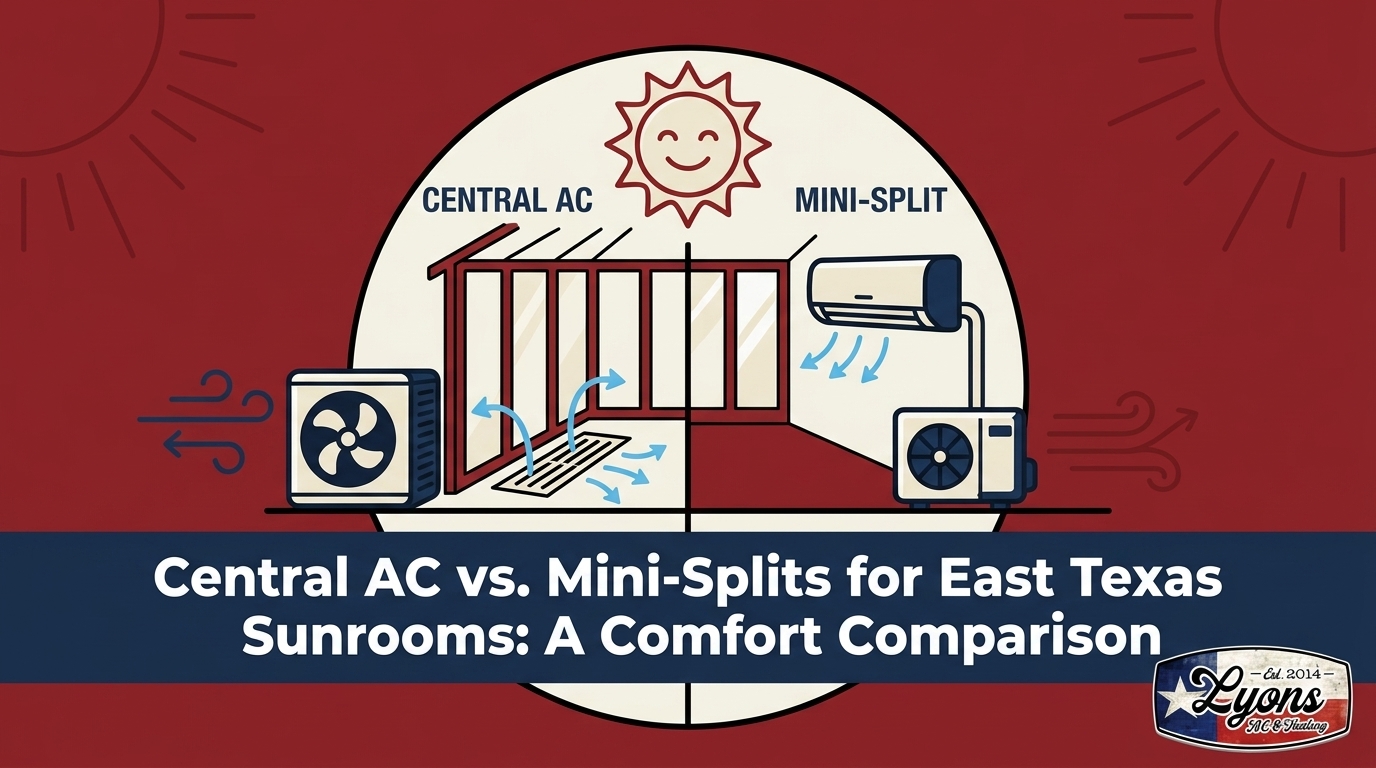
Central AC vs. Mini-Splits for East Texas Sunrooms: A Comfort Comparison
Treating a sunroom like a standard bedroom often leads to poor airflow and extreme heat. We compare duct extensions against dedicated ductless systems to solve solar heat gain.

The Sunroom Cooling Myth: Why Standard Approaches Fall Short
When homeowners ask us to evaluate Central AC vs. Mini-Splits for East Texas Sunrooms: A Comfort Comparison, we always start by explaining that treating a sunroom like just another bedroom is a major misconception. You might think that cooling a new addition is as simple as knocking a hole in the wall, running a few feet of ductwork, and adding a vent. However, our team at Lyons AC & Heating frequently sees how standard approaches fall short, as the sheer volume of glass completely changes the thermal dynamics of the space.
If you are struggling to keep your new addition comfortable, the peak July heat immediately exposes the flaws in under-designed HVAC setups. You find yourself facing a frustrating problem: extreme solar heat gain makes the room completely unusable during the hottest parts of the day. This forces a critical decision point. Do you try to force your existing central system to do more work by extending the ductwork, or do you install a dedicated ductless system to handle the load independently?
Need professional guidance for your home addition? Explore our comprehensive air conditioning solutions to find the right fit for your space.
To make the right choice, you have to look past the upfront simplicity of a duct extension. You need to understand the technical reality of how residential air conditioning systems handle high thermal loads. Central air conditioners are carefully balanced systems, and altering their airflow can have unintended consequences for every other room in your house.
The Physics of Cooling a Glass-Heavy Addition
Before you can decide on the right equipment, you have to understand exactly what you are fighting against. A sunroom is not a standard architectural structure. It behaves fundamentally differently than the rest of your home, and those differences require a specific engineering approach to overcome.
If you are considering a mini-split installation, it helps to know why these systems are so frequently recommended by our technicians for this exact application. The challenges of cooling a glass-heavy room break down into three primary physical hurdles:
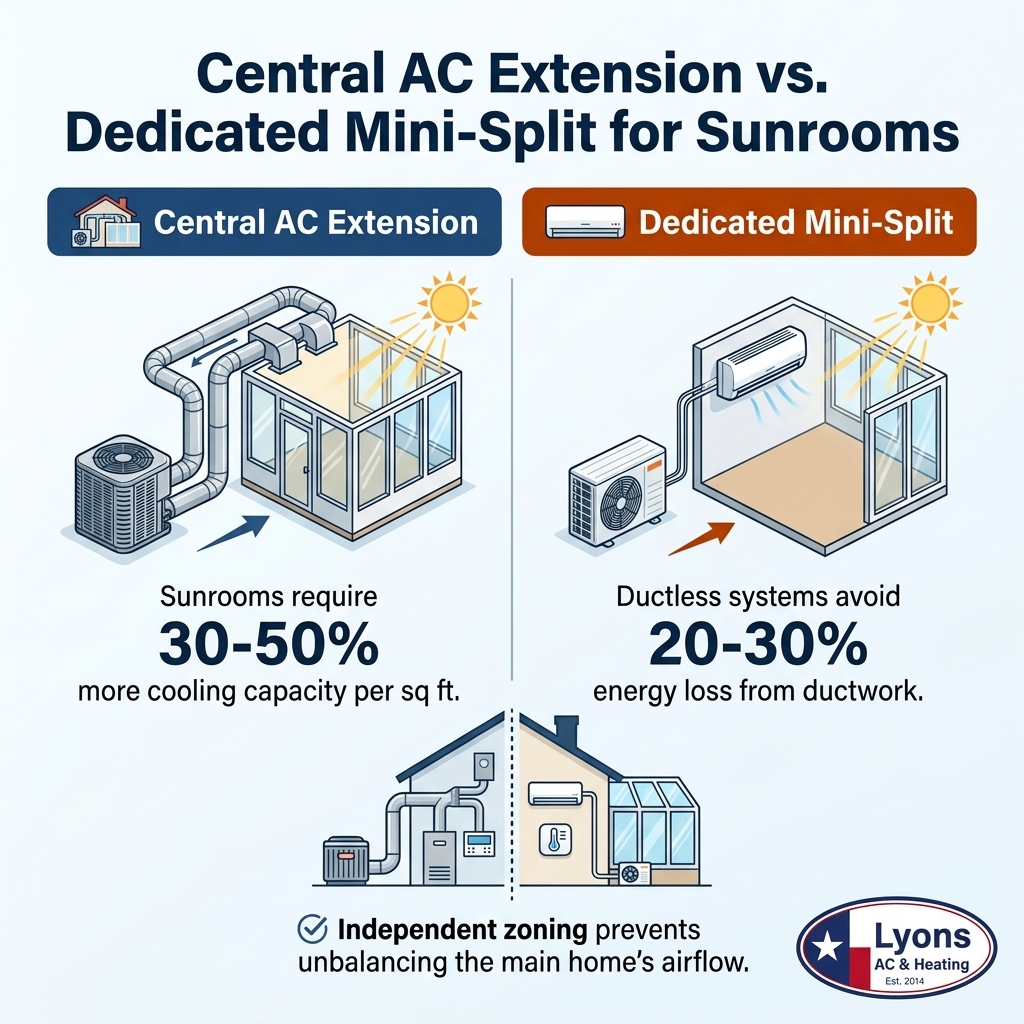
• The Greenhouse Effect: Extensive glass walls allow shortwave solar radiation to pour into the room. This sunlight hits your floors and furniture, heating them up. Those objects then radiate longwave heat energy, which cannot easily pass back out through the glass. This trapped heat means a sunroom often requires 30% to 50% more cooling capacity per square foot than a heavily shaded, standard bedroom.
• Lack of Traditional Insulation: The main walls of your home are packed with fiberglass or foam insulation, and the attic above has a thick thermal barrier. A sunroom replaces those insulated barriers with glass panes and often features a thin, uninsulated roof. Heat transfer happens rapidly, meaning your cooling system has to run constantly just to maintain a baseline temperature.
• Extreme Latent Heat Loads: In HVAC terms, "sensible heat" is the temperature you read on a thermometer, while "latent heat" is the energy trapped in airborne moisture. During East Texas humid summers, the latent heat load is massive. Your cooling system must work overtime to wring the humidity out of the air before the room will actually feel cool to your skin. Standard sensible cooling simply is not enough.
Because of these three compounding factors, a sunroom requires aggressive, continuous moisture removal and specialized temperature management that most standard home setups are not equipped to provide.
Option 1: Extending Your Existing Central Air Conditioning
For many homeowners, the first instinct is to tap into the equipment they already own. Extending your existing central air conditioning system into the new sunroom seems like the path of least resistance. You already have a condenser sitting outside and an air handler in the attic or closet. Why not just add a branch of ductwork and call it a day?
The perceived pros are obvious. You get to utilize your existing equipment, and you only have to manage a single thermostat for the entire house. However, the cons heavily outweigh the benefits, especially in a climate that demands peak performance from your HVAC system.
The Risk of Unbalanced Airflow
Airflow in a duct system is governed by static pressure. Air behaves a lot like water; it always takes the path of least resistance. If you add a new duct run into a sunroom, you alter the static pressure of the entire system. Because the sunroom requires so much cooling, a massive amount of conditioned air gets pulled into that single space.
This creates a common mistake we see among homeowners in Livingston TX: they inadvertently starve their main living areas of cold air just to keep a patio enclosure comfortable. Furthermore, the thermostat dictating the temperature is usually located in a central hallway. That hallway might be a comfortable 72 degrees, causing the AC to shut off, while the sunroom is baking at 85 degrees. If you move the thermostat to the sunroom to compensate, the system will run non-stop, turning the rest of your house into a freezing meat locker.
Capacity Limits of Your Current Unit
Most modern homes are built with HVAC systems that are perfectly sized for the original square footage. Air conditioning equipment is not designed with a massive surplus of capacity. If you have a 3-ton unit perfectly cooling a 1,500-square-foot house, adding 200 square feet of high-load, glass-heavy space completely exceeds the system's design limits.
Pushing an already maxed-out system during peak summer forces the compressor to run continuously. This lack of downtime causes immense wear and tear on the blower motor and the compressor itself. Over time, this constant strain leads to premature mechanical failure. You might find yourself in a situation where the AC fan stops working entirely right in the middle of a July heatwave, leaving your entire home without cooling.
Option 2: Installing a Dedicated Ductless Mini-Split
The alternative to modifying your central ductwork is to treat the sunroom as a completely independent climate zone. A dedicated ductless mini-split system operates independently of your main central air unit. It consists of a small outdoor compressor and a sleek, wall-mounted indoor air handler connected by a simple conduit line.
Because these systems do not rely on a sprawling network of ducts, they completely eliminate the 20% to 30% energy loss typically associated with ductwork distribution. Every ounce of cooling power goes directly into the sunroom, exactly where you need it most.
Handling the Greenhouse Effect Independently
Treating the sunroom as its own climate zone allows for precise temperature control regardless of what the main house needs. If the sun is beating down on the glass at 3:00 PM, the mini-split can ramp up to handle the load while the central AC in the main house continues operating normally.
This independent operation is powered by variable-speed inverter technology. Unlike traditional central air conditioners that blast on at 100% power and then shut off completely, an inverter-driven compressor adjusts its speed continuously. It can run at 30%, 50%, or 80% capacity depending on exactly what the room requires at that very second.
This continuous, lower-speed operation is the ultimate weapon against East Texas humid summers. Because the indoor coil stays cold constantly, it continuously wrings moisture out of the air. It combats high humidity without overcooling the space, leaving the room feeling crisp and comfortable rather than cold and clammy. Additionally, modern Daikin ductless systems offer a minimally invasive installation process. There is no need to tear up ceilings or rebuild soffits to hide bulky ductwork; the system can typically be installed and running in a single day.
Head-to-Head Comparison: Central Duct Extension vs. Mini-Split
To make the best decision for your home, it helps to look at exactly how these two approaches stack up against each other across the most critical performance metrics. Here is a direct comparison of what you can expect from each option.
• Upfront Invasiveness — Central Duct Extension: High. Requires cutting into existing trunk lines, routing new ducts through tight attic spaces, and opening drywall. — Dedicated Ductless Mini-Split: Low. Requires only a small 3-inch hole in the wall to connect the indoor and outdoor units.
• Peak Solar Load Performance — Central Duct Extension: Poor. Relies on a thermostat located in a different room, leading to severe temperature imbalances during sunny hours. — Dedicated Ductless Mini-Split: Excellent. Monitors the specific temperature of the sunroom and adjusts cooling output in real-time.
• Impact on Whole-Home Comfort — Central Duct Extension: Negative. Pulls conditioned air away from main living spaces, often starving bedrooms of necessary cooling. — Dedicated Ductless Mini-Split: Zero impact. Operates completely independently, preserving the delicate airflow balance of your main house.
• Humidity Control — Central Duct Extension: Limited. Single-stage operation struggles to remove heavy moisture without freezing out the rest of the home. — Dedicated Ductless Mini-Split: Superior. Variable-speed inverter technology runs continuously to extract deep, latent moisture effectively.
Why Accurate Load Calculations Matter More in Sunrooms
Regardless of which cooling method you lean toward, the most critical step in the process is properly sizing the equipment. In standard home construction, some contractors rely on outdated rules of thumb to guess how much cooling a room needs. In a sunroom, guessing is a guaranteed recipe for failure.
If you guess the BTU (British Thermal Unit) requirements for a glass-heavy room, you will almost always severely undercool the space. Conversely, if you panic and install a massive unit just to be safe, you create a different problem. An oversized unit will "short-cycle"—turning on, blasting the room with cold air for five minutes, and turning off before it has a chance to remove any moisture. This leaves the room feeling cold, damp, and clammy.
This is why proper sizing requires a professional Manual J load calculation. When evaluating HVAC services in Livingston, TX, you want a team like ours at Lyons AC & Heating that performs exact physics-based calculations rather than rule-of-thumb guessing. A proper calculation accounts for several specific variables:
1. Glass Type and Square Footage: Single-pane, double-pane, and Low-E coated glass all transfer heat at drastically different rates. A calculation measures exactly how much glass is present and how well it resists heat transfer.
2. Directional Facing (Sun Exposure): A sunroom facing west will take a brutal beating from the late afternoon sun, requiring a totally different cooling strategy than a room facing north.
3. Regional Latent Heat (Humidity): During East Texas humid summers, the calculation must account for the massive amount of airborne moisture that needs to be condensed and drained away.
4. Volume vs. Square Footage: Sunrooms often feature vaulted or elevated ceilings. A calculation measures the total cubic volume of air that needs to be conditioned, not just the floor space.
Frequently Asked Questions About Sunroom Cooling
Can I extend my central AC to a new addition?
Yes, it is physically possible to extend your central AC to a new addition, but it is rarely recommended for sunrooms. Your existing AC was sized for your home's original footprint. Adding ductwork to a new space alters the static pressure of the entire system, pulling air away from your main living areas. This usually results in a sunroom that is still too warm and a main house that is suddenly struggling to stay cool.
Why is my sunroom so hot even with AC?
Your sunroom is hot because the extreme solar heat gain and lack of traditional insulation overwhelm the cooling capacity being delivered. Glass traps heat through the greenhouse effect, meaning the room requires significantly more BTUs per square foot than a normal bedroom. If your AC is controlled by a thermostat in a cooler part of the house, the system simply shuts off before the sunroom ever reaches a comfortable temperature.
What is the best way to cool a sunroom in Texas?
The best way to cool a sunroom in Texas is by installing a dedicated ductless mini-split system. Texas heat and high humidity require aggressive, continuous cooling that independent zoning handles perfectly. A mini-split uses variable-speed technology to constantly remove moisture and adjust to the intense afternoon sun without freezing out the rest of your home.
Does a mini-split add value to a sunroom addition?
Yes, a professionally installed mini-split adds significant functional and financial value to a sunroom addition. By providing reliable, independent climate control, it transforms a seasonal patio enclosure into a true year-round living space. Appraisers and future buyers recognize the value of a room that is actually comfortable to use during peak summer heat without straining the main home's HVAC system.
How many BTUs do I need to cool a glass-enclosed patio?
There is no single answer, as the required BTUs depend entirely on the size of the room, the type of glass, ceiling height, and directional sun exposure. While a standard room might need 20 BTUs per square foot, a glass-enclosed patio often requires 40 to 60 BTUs per square foot to combat solar heat gain. A professional load calculation is the only way to determine the exact capacity needed to keep the space comfortable.
Making the Right Comfort Choice for Your Home Addition
While extending a duct from your existing central air conditioner might seem cheaper and easier upfront, the physics of cooling a glass-heavy space tell a very different story. A dedicated ductless mini-split is structurally and financially smarter for long-term comfort. It protects the airflow balance of your main house while providing the aggressive, independent humidity control required for Livingston TX weather.
The ultimate goal of your home addition is to create a usable, comfortable space where you can relax—not a hotbox that compromises the rest of your home. If you are ready to stop guessing and start enjoying your new room, schedule a professional assessment today to let our team run a precise, physics-based load calculation for your specific sunroom.
Customer Testimonials
Our customers consistently praise our exceptional service and attention to detail, making us a trusted choice for all your HVAC needs.
Service Areas
Our service areas cover a wide range of locations, ensuring that we can meet your needs wherever you are. We are committed to providing top-notch service in every region we operate.