

Managing Indoor Humidity When Your AC Runs Non-Stop in July
When your AC runs all afternoon but leaves your home cold and clammy, lowering the thermostat won't solve the problem. Here is why this July paradox happens and the right way to fix it.
The July Paradox: Why Your Home Feels Cold But Clammy
The arrival of July peak summer brings intense, sweltering weather to East Texas, making managing indoor humidity when your AC runs non-stop in July a frustrating priority for many homeowners. Here at Lyons AC & Heating, our team fields countless calls from Livingston residents experiencing the exact same issue: you hear the compressor humming outside all afternoon, and the vents are blowing cold air, yet the house still feels incredibly sticky. You might find yourself constantly wiping condensation off the windows or noticing that your floors feel strangely damp. This is the July paradox: your air conditioning system is working overtime, but your living space remains completely uncomfortable.
If you are dealing with this exact scenario, our technicians want you to know you are not alone. When an HVAC system fails to dehumidify a home properly, the natural instinct is to simply lower the thermostat. However, pushing an already struggling system harder often makes the clammy feeling worse. To truly solve the problem, you need to look beyond the temperature reading on your wall and understand how your home handles moisture.
For comprehensive help with your cooling system, learn more about our air conditioning services.
The East Texas Climate Factor
Air conditioners are designed to do two jobs simultaneously: remove heat and remove moisture. In dry climates, removing heat is the primary challenge. However, in our region, the intense heat is always paired with extreme humidity. During the peak of summer, your cooling system is fighting a massive battle against moisture infiltration. When the system runs continuously but leaves you feeling sticky, it means the equipment is successfully lowering the temperature but completely failing at moisture extraction.
Here is what our Lyons AC & Heating technicians usually see in the field: Homeowners assume that cold air equals a working system. But true comfort requires a delicate balance. To get your home back to a comfortable state, we have to explore the root causes of this failure, which range from simple thermostat settings to complex mechanical sizing and ductwork integrity issues.
How Your System Balances Sensible and Latent Cooling
To understand why your living room feels like a swamp despite the cold air, it helps to know how your equipment actually works. HVAC professionals divide the cooling process into two distinct categories: sensible cooling and latent cooling. When Livingston TX area homes struggle with high indoor humidity, it almost always points to a failure in the latent cooling process.
Defining the Two Types of Cooling
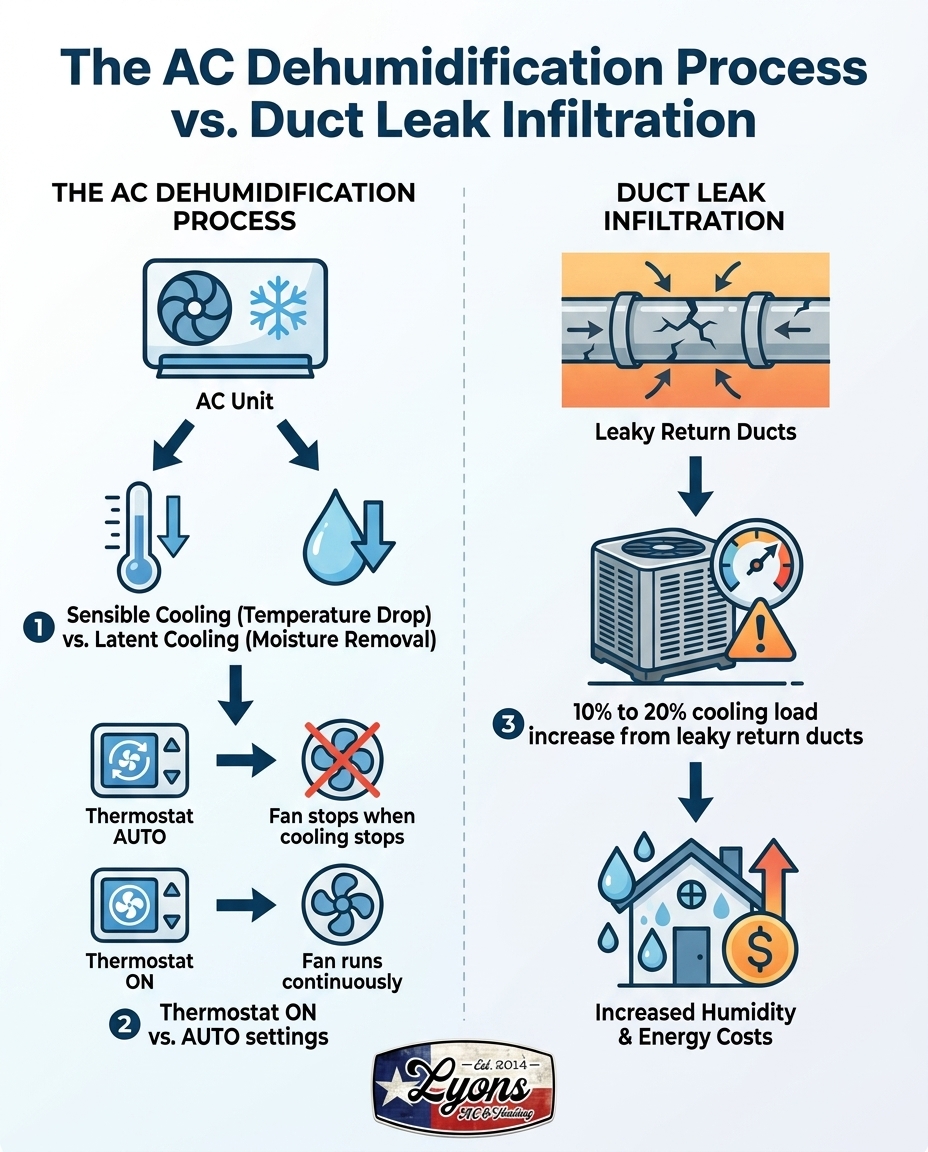
Sensible cooling refers to the actual drop in temperature that you can feel and measure with a thermometer. When your thermostat drops from 78°F to 72°F, that is sensible cooling in action. Latent cooling, on the other hand, is the removal of moisture from the air. You cannot measure latent cooling with a standard thermometer, but you absolutely feel its absence when the air is thick and heavy.
• Sensible Cooling — What It Does: Lowers the air temperature in the room. — How You Measure It: Standard wall thermostat or thermometer. — Signs of Failure: The house stays hot; vents blow warm air.
• Latent Cooling — What It Does: Extracts water vapor (humidity) from the air. — How You Measure It: Hygrometer (measures relative humidity). — Signs of Failure: The house is cold but feels sticky, damp, or clammy.
The Role of Your Evaporator Coil
Your air conditioner removes humidity using the indoor evaporator coil. Warm, moist air from your home is pulled through the return vents and blown over this freezing cold metal coil. As the warm air hits the cold surface, the moisture in the air condenses into liquid water—just like water droplets forming on the outside of a cold glass of iced tea on a hot day. This liquid water drips into a drain pan and is carried out of your home.
Peak summer represents the highest latent cooling load your system will face all year. The air outside is saturated with moisture, and every time you open a door, cook a meal, or take a shower, you add to that moisture load. If your AC runs non-stop but the home remains humid, the system is achieving sensible cooling but failing completely at latent cooling. Exploring advanced indoor air quality solutions is often necessary to bridge this gap and restore true comfort.
The Thermostat 'ON' Setting: A Common Humidity Trap
Before diving into complex mechanical repairs, there is one user error we frequently spot on service calls that drastically increases indoor humidity without requiring a single tool to fix. The fan setting on your thermostat plays a massive role in how your home handles moisture during the July peak summer heat.
The Difference Between ON and AUTO
Most thermostats have a fan switch with two options: "ON" and "AUTO."
• The AUTO setting: The indoor blower fan only runs when the outdoor compressor is actively cooling the air. When the cooling cycle finishes, the fan shuts off.
• The ON setting: The indoor blower fan runs constantly, 24 hours a day, regardless of whether the outdoor compressor is running.
The Re-Evaporation Effect Explained
Leaving the fan set to "ON" is a massive humidity trap. Here is why: during a cooling cycle, your evaporator coil gets soaking wet as it extracts moisture from the air. When the outdoor compressor shuts off, that coil is still dripping wet. If your indoor fan continues to blow air over that wet coil (because it is set to "ON"), it picks up all that resting moisture and blows it straight back into your living space.
This process is known as re-evaporation. You are essentially paying to pull humidity out of the air, and then paying again to blow it right back in.
Our professional recommendation: Always verify that your thermostat fan is set to "AUTO." This ensures that moisture stays on the coil and drips down the drain line instead of being pushed back into your bedrooms and living areas. If your fan is already set to AUTO and the humidity persists, the problem lies deeper within the system.
Hidden Attic Infiltration: The Impact of Leaky Return Ducts
If your thermostat settings are correct but the air still feels thick, the culprit is often hiding directly above your ceiling. Ductwork integrity is one of the most overlooked aspects of indoor comfort, specifically when it comes to return ducts pulling unconditioned air into the system.
Why Attic Air is the Enemy of Comfort
Your duct system has two sides: supply ducts (which blow cold air into the rooms) and return ducts (which pull warm air back to the unit). The return side of your ductwork operates under negative pressure—it acts like a giant vacuum cleaner. If there are any gaps, cracks, or disconnected joints in the return ducts running through your attic, that vacuum will suck in whatever air is surrounding it.
During summer afternoons, attic temperatures and humidity levels in East Texas peak drastically. Attics can easily reach 130°F or higher, and the air is heavily saturated with moisture. When leaky return ducts pull this superheated, wet air directly into your AC system, it completely overwhelms the equipment's dehumidification capacity. The system has to work so hard just to cool down the boiling attic air that it never gets the chance to extract the moisture properly.
The Dangers of DIY Duct Sealing
In our years inspecting local ductwork, our team has found that leaky return ducts can increase cooling loads by 10% to 20%. This forces the system to run constantly while still leaving Livingston TX area homes feeling sticky.
While it might be tempting to grab a roll of tape and head into the attic, DIY duct sealing is highly discouraged. Your HVAC system relies on precise pressure balances to move air safely and efficiently. Improperly sealing ducts without measuring static pressure can severely restrict airflow, leading to frozen coils, burnt-out blower motors, and even worse humidity problems. Because ductwork repairs require specialized diagnostic tools to verify airflow, it is always best to rely on professional HVAC services to evaluate and permanently correct attic infiltration.
System Sizing: Contrasting Non-Stop Runs with Short-Cycling
Another major reason we see air conditioners fail to remove humidity is improper system sizing. Your HVAC equipment must be perfectly matched to the square footage, layout, and thermal envelope of your home. When sizing is incorrect, the latent cooling process falls apart entirely.
The Goldilocks Zone of AC Sizing
An adequately sized air conditioner needs long, steady cycles to effectively extract moisture. It takes about 10 to 15 minutes of continuous operation before the evaporator coil gets cold enough to start pulling significant amounts of water out of the air.
If a system is struggling to keep up—perhaps because it is slightly undersized, battling severe duct leaks, or facing the absolute extremes of the July peak summer heat—it will run non-stop. While running constantly usually helps with dehumidification, it fails if the incoming moisture load (from attic leaks or outdoor infiltration) is simply too high for the tonnage of the unit.
The Short-Cycling Extreme
Conversely, if a system is oversized for the home, it creates a completely different operational failure known as short-cycling. An oversized unit blasts the house with a massive amount of cold air, dropping the temperature rapidly. Because the thermostat is satisfied quickly, the system shuts off after just 5 or 10 minutes.
• The result: The system achieves sensible cooling almost instantly, but it never runs long enough to achieve latent cooling.
• The environment: The air feels cold, damp, and swampy because all the humidity was left behind.
Both extremes—running constantly without overcoming the moisture load, or shutting off too quickly—result in terrible indoor air quality. If you notice your unit turning on and off rapidly, learning more about why your AC short cycles can help you identify if oversized equipment is the root cause of your humidity issues.
Why Dropping the Temperature Exacerbates the Clammy Feeling
When you are sitting on the couch feeling sticky and uncomfortable, the most common reaction is to walk over to the thermostat and drop the temperature down to 68°F. It seems logical: if you are uncomfortable, make it colder. However, when high humidity is the actual problem, lowering the temperature usually backfires and makes the clammy feeling significantly worse.
The Science of Relative Humidity
To understand why this happens, we have to look at how air holds moisture. Warm air has the capacity to hold a lot of water vapor. Cold air can only hold a small amount of water vapor.
Relative humidity is a percentage that describes how full the air is compared to its maximum capacity. If you take a room full of humid air and simply lower the temperature without removing any water, the air's capacity to hold moisture shrinks. Because the amount of water in the air stayed the same, but the capacity shrank, the relative humidity percentage goes up.
What this means for you: By dropping the thermostat to 68°F without fixing the moisture removal issue, you are actively increasing the relative humidity in your home. The air will feel even clammier, heavier, and more uncomfortable on your skin.
The Risk of Freezing the System
Furthermore, forcing an already struggling system to run continuously at very low temperature settings risks severe mechanical damage. When Livingston TX area homes try to force a system down to 68°F while it is battling heavy moisture loads, the evaporator coil can easily drop below freezing. The condensation on the coil turns to solid ice, completely blocking airflow and shutting down the cooling process entirely. The solution to a sticky home is always moisture removal, not just generating colder air.
Professional Diagnostics for Extreme Summer Conditions
When you are caught in the paradox of an AC that runs constantly but leaves you feeling damp, basic maintenance is rarely enough to solve the problem. Generic AC tune-ups or simply changing an air filter won't fix structural duct leaks in the attic, nor will they correct an oversized unit that is short-cycling.
Beyond the Basic Tune-Up
Solving complex latent cooling failures requires a professional diagnostic approach. A licensed technician must evaluate the system as a whole. This process includes:
1. Evaluating ductwork integrity: Checking the return side for negative pressure leaks that pull in humid attic air.
2. Measuring airflow: Using specialized tools to ensure the blower motor is moving the exact right amount of cubic feet per minute (CFM) across the coil.
3. Assessing pressure imbalances: Ensuring that closed doors or blocked vents aren't creating pressure zones that force unconditioned air into the living space.
At Lyons AC & Heating, our technicians bring decades of hands-on expertise in diagnosing the complex sizing and ductwork issues that compromise indoor air quality in East Texas homes. We understand exactly how the local climate impacts equipment performance, and our crews know precisely where to look when a system fails to dehumidify. Relying on experienced professionals like us is the only way to safely and permanently correct these structural airflow issues.
If you are tired of fighting a losing battle against indoor humidity, it is time to stop lowering the thermostat and start addressing the root cause. Reach out to contact our cooling experts today, and let us restore true, dry comfort to your home.
Frequently Asked Questions
Why is my house so humid with the AC running?
Your house remains humid because the system is successfully lowering the temperature (sensible cooling) but failing to extract moisture (latent cooling). This often points to an oversized AC unit that short-cycles, or leaky return ducts pulling wet attic air into the home. Addressing these structural issues is necessary to restore comfort.
Why does my AC run all day but the house feels sticky?
A constantly running AC that leaves the house sticky is usually battling a massive moisture load it cannot overcome. This can happen if the thermostat fan is set to "ON" (which re-evaporates moisture back into the air) or if unconditioned outside air is infiltrating the ductwork. The system is essentially working overtime just to fight the incoming humidity.
Does running the AC constantly reduce humidity?
Running the AC constantly only reduces humidity if the system is properly sized and the ductwork is fully sealed. If the system is pulling in humid air from the attic through return leaks, running it constantly will actually make the house feel worse. Proper moisture extraction requires long, steady cycles in a sealed environment.
How do I lower the humidity in my house in the summer?
The first step is verifying your thermostat fan is set to "AUTO" rather than "ON" so moisture isn't blown back into the rooms. Next, ensure your air filters are clean to promote proper airflow over the evaporator coil. If humidity persists, our technicians can evaluate your ductwork for leaks and verify your system is sized correctly.
Can a dirty air filter cause high indoor humidity?
Yes, a severely clogged air filter restricts airflow across the indoor evaporator coil. When airflow is restricted, the coil cannot efficiently extract heat or moisture from the air circulating through your home. While a fresh filter is a good starting point, persistent humidity usually requires deeper mechanical diagnostics.
Customer Testimonials
Our customers consistently praise our exceptional service and attention to detail, making us a trusted choice for all your HVAC needs.
Service Areas
Our service areas cover a wide range of locations, ensuring that we can meet your needs wherever you are. We are committed to providing top-notch service in every region we operate.