
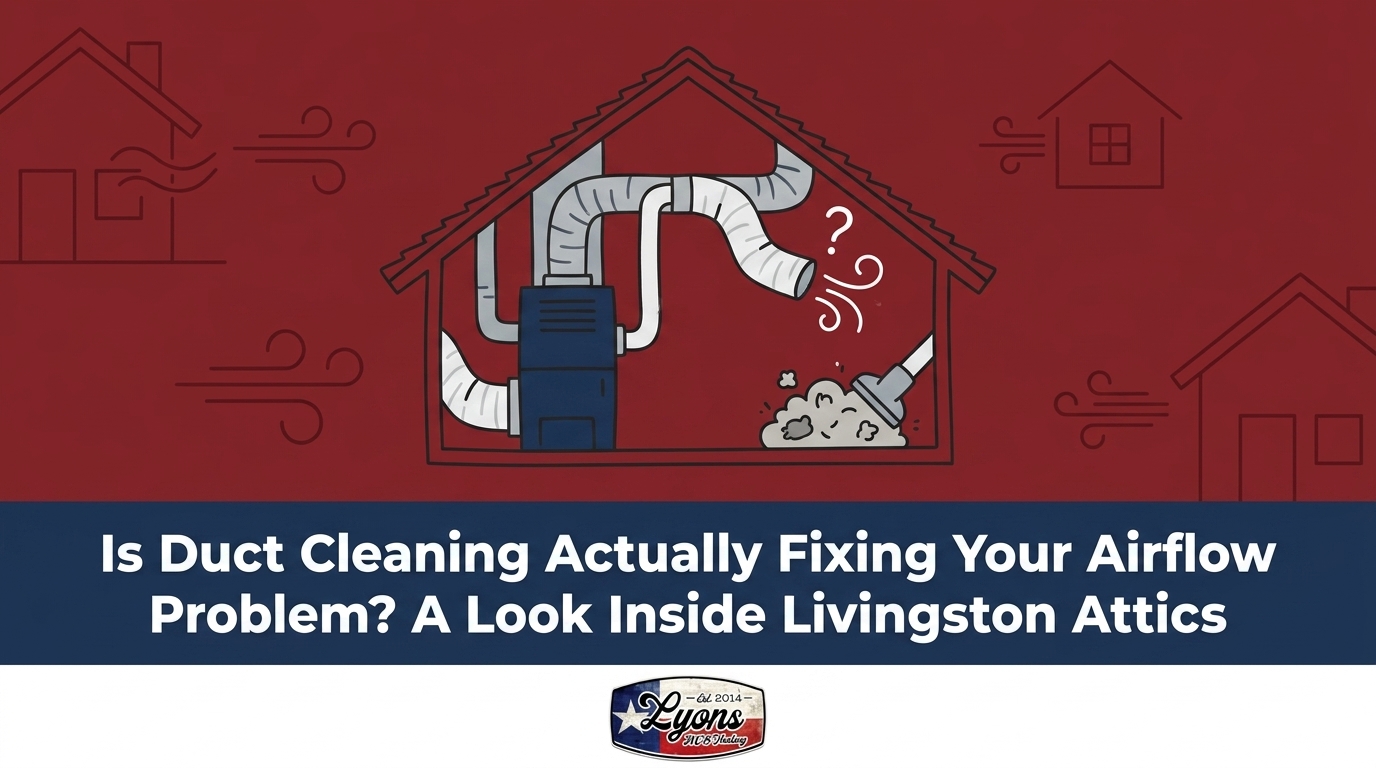
Is Duct Cleaning Actually Fixing Your Airflow Problem? A Look Inside Livingston Attics
Many homeowners assume weak AC airflow means their vents are clogged with dust. Discover why a sudden drop in air volume is usually a mechanical issue, not a dirty duct.
Why Weaker Airflow Isn't Always a Dust Problem
Your air conditioner is running nonstop, but the house still feels warm, and the cool breeze you expect from your vents has turned into a weak trickle. When we field emergency calls at Lyons AC & Heating during the peak of summer, homeowners experiencing a sudden drop in indoor comfort often ask us: is duct cleaning actually fixing your airflow problem? A look inside Livingston attics reveals a surprising truth. Many homeowners assume that if air is struggling to reach the living room, the ductwork must be clogged with years of dust, pet hair, and debris. This leads to a frustrating cycle of paying for superficial cleaning services while the house remains uncomfortably warm.
The reality our team typically sees is that progressively weaker airflow is rarely a dust problem. While dirty ducts certainly impact the cleanliness of your indoor air, a sudden or severe drop in air volume at the register points to a much more serious mechanical issue. When the air stops pushing forcefully through your home, the root cause is almost always a failing component within the HVAC system itself, rather than a physical blockage in the ductwork. Understanding this difference is the crucial first step in making the right decision for your home comfort and your wallet.
For a comprehensive look at your HVAC system performance and professional indoor air quality solutions, prioritizing a true mechanical evaluation is key.
The Physics of Airflow: Dust Accumulation vs. Mechanical Failure
To understand why cleaning your ducts won't magically restore strong airflow, we have to look at the physics of how air moves through your home. Airflow is generated by a mechanical blower motor that pulls warm air from your house, pushes it over a cold evaporator coil, and forces it back through the ductwork. For airflow to stop entirely, something must either physically block that massive volume of moving air or stop the motor from pushing it in the first place.
How Dust Actually Affects Your System
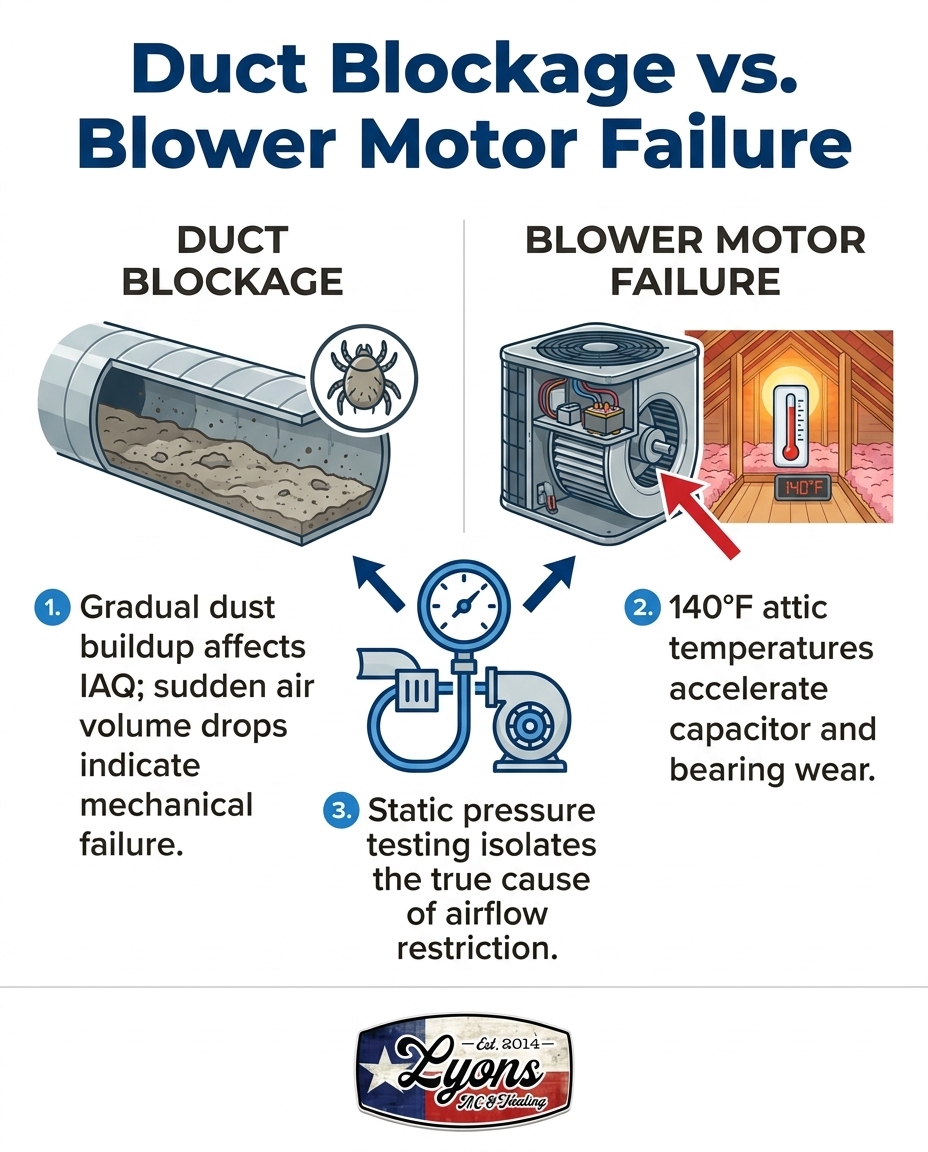
The gradual buildup: When dust enters your ductwork, it doesn't form a solid wall. Instead, it creates a thin, even coating along the interior surfaces of the ducts. This layer of dust impacts your indoor air quality and can eventually coat your evaporator coil, which reduces the system's ability to cool the air. However, a standard layer of dust simply does not have the sheer mass required to stop a healthy, high-powered blower motor from pushing air into your rooms.
The Environmental Protection Agency (EPA) explicitly notes in its Guide to Indoor Air Quality that duct cleaning has not been shown to significantly improve airflow unless there is a near-total, physical blockage—such as a collapsed duct or a massive foreign object trapped inside. A normal accumulation of household dust will not choke off your system's air supply.
When Air Volume Suddenly Drops
The mechanical reality: A noticeable, severe drop in air volume at the register points directly to a mechanical failure. If the blower motor cannot spin at its designated speed, the volume of air moving through the ducts plummets. This creates a scenario that feels exactly like a blockage, but is actually a lack of propulsion.
• Airflow Strength — Dust Accumulation Issue: Remains generally consistent and strong. — Mechanical Blower Failure: Noticeably weak, intermittent, or completely stopped.
• Timeline of Issue — Dust Accumulation Issue: Develops gradually over several years. — Mechanical Blower Failure: Happens suddenly or worsens rapidly over a few weeks.
• Primary Complaint — Dust Accumulation Issue: Increased allergies, visible dust on furniture. — Mechanical Blower Failure: House feels hot, AC runs constantly, weak breeze at vents.
• Effective Solution — Dust Accumulation Issue: Professional duct cleaning and filtration upgrades. — Mechanical Blower Failure: Mechanical repair or replacement of the blower motor.
Understanding this distinction saves you from investing in a cleaning service when what your system actually needs is a mechanical repair.
How Sweltering Summer Attics Destroy Blower Motors
The location of your HVAC equipment plays a massive role in its lifespan and performance. In many homes, the indoor air handler—which houses the sensitive blower motor—is located in an unconditioned attic space. This creates an incredibly harsh operating environment, especially during the peak of summer.
The Impact of 140°F Ambient Heat
When peak July heat sets in, our technicians routinely measure temperatures inside unconditioned Livingston TX attics that easily exceed 140°F. Your HVAC system is already working overtime to cool your home, and it has to do so while sitting in a superheated environment. This intense ambient heat places immense thermal strain on every mechanical and electrical component inside the air handler. Systems must work exponentially harder to shed heat, and thermal overload often causes built-in safety mechanisms to trip or components to degrade prematurely.
Capacitor and Bearing Failure
Electrical breakdown: The blower motor relies on an electrical component called a capacitor to provide the initial jolt of energy needed to start spinning, and to keep it running smoothly. Capacitors contain fluid that helps them hold an electrical charge. In 140°F attic heat, this fluid can literally begin to boil and expand, causing the capacitor to swell, lose its charge, and eventually fail. When the capacitor degrades, the motor struggles to start or runs at a significantly reduced speed.
Mechanical wear: Additionally, the motor relies on physical bearings to spin without friction. Extreme, prolonged heat dries out the factory lubricants packed into these bearings. Without proper lubrication, the metal bearings grind against each other. This friction slows the motor down and generates even more heat. As the motor spins slower, you experience low air volume at the register, perfectly mimicking the effect of heavily blocked ducts.
Key Symptoms of a Failing Blower Motor
If you are experiencing weak airflow, there are several distinct warning signs that point to a failing blower motor rather than dirty ductwork. Knowing what to listen and look for can help you identify a mechanical problem before the system breaks down completely.
1. Strange, persistent noises: A healthy blower motor operates with a smooth, quiet hum. If you hear a loud screeching or squealing sound coming from your vents or the attic, it typically indicates that the motor bearings have lost their lubrication and are grinding. A loud buzzing or humming sound that doesn't result in airflow usually points to a failed capacitor trying to start a seized motor.
2. Intermittent airflow: If the air blows strong when the AC first turns on, but gradually weakens to a trickle after ten or fifteen minutes, the motor is likely overheating. As it gets too hot, thermal overload switches force the motor to slow down or shut off to prevent a fire.
3. Burning electrical smells: A failing motor that is working too hard draws excessive electrical current, causing the internal wiring to overheat. If you detect a faint, acrid smell similar to burning plastic or hot metal coming from your air vents, shut the system off immediately.
4. Low air volume without pressure changes: A classic sign of motor failure is low air volume at the register without a corresponding increase in static pressure inside the ductwork. If the ducts were truly blocked, pressure would build up behind the blockage. If there is no pressure and no air, the motor simply isn't pushing.
If you notice these issues, recognizing the signs of a failing furnace blower motor can save you from a complete breakdown during the hottest part of the year.
The Danger of Treating Mechanical Strain with Duct Cleaning
One of the most common pitfalls homeowners face is misdiagnosing mechanical strain as an air quality issue. It is a common industry practice for some companies to use airflow complaints as an opportunity to upsell extensive duct cleaning services. While duct cleaning has its place in home maintenance, using it to treat a dying blower motor is both ineffective and risky.
The financial waste: Paying for a comprehensive duct cleaning while your blower motor is failing wastes hundreds of dollars. The cleaning crew will remove the standard layer of dust from the duct walls, but when you turn the system back on, the weak airflow will persist because the motor is still struggling to spin. You are left with clean ducts but an uncomfortably hot house.
The risk of complete breakdown: More importantly, ignoring a failing motor delays necessary repairs. If a struggling motor is left to run continuously during peak summer in Livingston TX, it will eventually burn out completely. This can cause the evaporator coil to freeze solid, potentially damaging the compressor outside. What could have been a straightforward motor replacement escalates into a massive, expensive system failure.
In our experience rescuing Livingston homeowners from mid-summer breakdowns, a pattern we see far too often is residents paying for duct cleanings when their blower motor is actually failing. This is exactly why our team at Lyons AC & Heating is committed to honest, accurate diagnostics. Finding the actual root cause of an airflow problem ensures that you only pay for the repairs you truly need, rather than pushing unnecessary duct cleaning as a cure-all for mechanical issues.
Expert Diagnostics: Testing Static Pressure and Amp Draw
Because weak airflow can stem from multiple mechanical factors, our technicians never guess whether a motor is failing. Diagnosing the exact cause requires specialized tools and licensed expertise. Professionals measure the system's performance using concrete data. Attempting to diagnose or repair a blower motor yourself involves dealing with high-voltage electricity and is highly dangerous.
Understanding Static Pressure
The blood pressure check of HVAC: Static pressure testing is how professionals measure the resistance of air moving through your system. Using a specialized tool called a manometer, technicians measure the pressure inside the supply and return ducts. If the static pressure is exceptionally high, it indicates a severe restriction—such as a completely collapsed duct, a blocked evaporator coil, or a heavily clogged air filter.
However, if the static pressure is low, and you still have low air volume at the register, it proves that the ductwork is clear but the blower motor is failing to generate enough force to move the air.
Evaluating Electrical Health
Measuring amp draw: To confirm the health of the blower motor, technicians use a multimeter to measure the amp draw—the amount of electrical current the motor is using to turn the blower wheel. Every motor has a specific amp rating listed on its data plate. If the motor is drawing significantly more amps than it is rated for, it means it is overworking, overheating, and on the verge of failure.
Combining static pressure readings with electrical amp draw provides undeniable proof of the system's condition, taking the guesswork out of air conditioning airflow troubleshooting.
Long-Term Solutions for Optimal Airflow and Dehumidification
Proper airflow is about much more than just feeling a cool breeze; it is essential for the overall climate control of your home. In a subtropical climate like Livingston TX, managing indoor humidity is just as important as lowering the temperature.
The role of airflow in dehumidification: Your air conditioner removes humidity by passing warm, moist indoor air over the freezing cold evaporator coil. The moisture in the air condenses on the coil and drains away. For this process to work correctly, the blower motor must push a very specific volume of air over the coil. If the airflow is too weak, the coil can freeze over. If the air moves too slowly, the system cannot cycle enough air to effectively remove the heavy, oppressive indoor humidity.
Weak airflow exacerbates indoor humidity, making your home feel sticky and much hotter than the thermostat reads. The best defense against these extreme attic conditions and mechanical failures is routine mechanical maintenance. Having a professional inspect the motor, test the capacitors, and measure the amp draw before the peak heat arrives ensures your system is ready for the workload.
Verifying the mechanical health of your system through proper heating system diagnostics and cooling inspections ensures that any subsequent investments you make in indoor air quality—including duct cleaning—are actually effective and worthwhile.
Frequently Asked Questions About Airflow and Duct Health
Does duct cleaning improve airflow?
The short answer is no, duct cleaning rarely improves airflow. According to the EPA, a normal accumulation of dust does not restrict the volume of air moving through your system. Unless you have a near-total physical blockage, such as a collapsed duct or a large foreign object trapped inside, cleaning the ducts will not increase the strength of the breeze coming from your vents.
Why is there low air volume at the register?
Low air volume at the register is usually caused by a mechanical failure or an extreme restriction. The most common culprits are a failing blower motor, a degraded capacitor, a heavily clogged air filter, or a frozen evaporator coil. These issues prevent the system from generating or pushing the necessary volume of air through the ductwork.
How do I know if my AC blower motor is failing?
You can identify a failing blower motor by paying attention to unusual sounds and airflow patterns. Screeching, grinding, or humming noises coming from the air handler are strong indicators. Additionally, if the airflow starts strong but weakens after a few minutes, or if you smell a burning electrical odor near your vents, the motor is likely overheating and failing.
Can dirty air ducts cause my AC to stop blowing cold air?
Dirty air ducts alone will not cause your AC to stop blowing cold air, but the dust can contribute to secondary problems. If the dust from the ducts coats the evaporator coil heavily enough, it acts as an insulator, preventing the coil from absorbing heat. This can cause the system to blow lukewarm air or lead to the coil freezing completely.
Is it normal for airflow to be weaker in certain rooms?
It is common for rooms furthest from the indoor air handler to have slightly weaker airflow due to the distance the air must travel. However, a severe drop in airflow in just one room usually indicates an issue with that specific duct run, such as a disconnected joint, a crushed flexible duct, or a closed damper, rather than a system-wide motor failure.
How does extreme heat affect my HVAC blower motor?
Extreme heat, such as the 140°F temperatures found in unconditioned summer attics, places severe thermal strain on the blower motor. The heat causes the fluid inside the start capacitor to degrade and boil off, and it dries out the lubricants inside the motor bearings. This leads to increased friction, electrical failure, and a rapid decline in the motor's ability to push air.
Take the Guesswork Out of Your System's Performance
Dealing with poor airflow during the peak of summer is incredibly frustrating, especially when you are unsure if you need a simple cleaning or a major repair. Assuming that dust is the culprit can lead to wasted money on superficial services while the real mechanical problem worsens in your attic.
Instead of guessing, the right next step is to rely on concrete data. A professional mechanical diagnostic will test your static pressure and motor amp draw, revealing exactly why you have low air volume at the register. By prioritizing mechanical health over blind cleaning, homeowners in Livingston TX can resolve their airflow issues accurately and restore true, reliable comfort to their homes.
Customer Testimonials
Our customers consistently praise our exceptional service and attention to detail, making us a trusted choice for all your HVAC needs.
Service Areas
Our service areas cover a wide range of locations, ensuring that we can meet your needs wherever you are. We are committed to providing top-notch service in every region we operate.