

Why AC Units Near Lake Livingston Freeze Up in July (And How to Thaw Them)
Extreme summer humidity can quickly turn your cooling system into a solid block of ice. Find out what steps you must take to safely thaw a frozen evaporator coil before permanent damage occurs.

When Your Cooling System Turns into a Block of Ice During a Heatwave
At Lyons AC & Heating, we often receive emergency calls from homeowners who walk past a vent, expecting a blast of cold air, only to feel a weak, lukewarm breeze—and when they check the indoor equipment, they realize exactly why AC units near Lake Livingston freeze up in July (and how to thaw them). Your evaporator coil or the copper refrigerant lines are completely encased in a thick layer of solid white ice. It is an incredibly frustrating paradox: your cooling equipment is literally freezing cold, yet your house is rapidly heating up. When July peak heat strikes and daytime temperatures frequently exceed 93 degrees, an iced-over system is a serious emergency that demands immediate action.
This sudden failure happens because the equipment is running continuously under immense strain to combat the extreme summer weather. You are now facing a dual challenge: you must safely melt the ice right away to prevent permanent water damage or compressor failure, and you must identify the root cause so the system does not freeze again the moment you turn it back on. To keep your home comfortable and safe, understanding the unique environmental stressors of lakeside living is crucial. When you are relying on your air conditioning systems to survive the summer, scheduling preventative AC maintenance is the most effective way to avoid this exact failure.
The Hidden Danger of Operating a Frozen System
Our technicians frequently see homeowners make the mistake of leaving the thermostat set to "cool" when they notice the house warming up, assuming the system just needs more time to catch up. Do not do this. If you continue to demand cooling from an iced-over unit, the compressor outside will overwork itself trying to pump refrigerant through a blocked system. This can lead to catastrophic compressor failure, turning a manageable thawing process into an incredibly expensive full-system replacement.
The Lake Livingston Microclimate: Why High Humidity Stresses Your System
To understand why freeze-ups happen so frequently here, you have to look at the unique environment surrounding your home. In our years serving the local community, we've seen how the Lake Livingston area is dominated by an 83,000-acre surface area of water that constantly evaporates under the intense Texas sun. This massive evaporation significantly elevates local dew points and relative humidity, creating a drastically heavier condensation load on residential cooling equipment than you would find just a few counties inland.
Your air conditioner does not just cool the air; it acts as a massive dehumidifier. Inside your indoor unit, the evaporator coil normally operates at around 40 degrees Fahrenheit. As warm, humid house air blows across this cold metal coil, the airborne moisture condenses into liquid water, drips into a drain pan, and exits your home. However, the sheer volume of moisture in a lakeside microclimate pushes this process to its absolute limits.
The Condensation Load Factor
While all residential cooling systems handle moisture, lakeside systems are forced to extract gallons of water from the air every single day. Here is a breakdown of how the local humidity impacts your equipment:
• Relative Humidity — Standard Inland Climate: Moderate (40% - 50%) — Lake Livingston Microclimate: Consistently High (60% - 80%+)
• Coil Condensation — Standard Inland Climate: Light, steady dripping — Lake Livingston Microclimate: Heavy, continuous water extraction
• Freeze Risk — Standard Inland Climate: Low to Moderate — Lake Livingston Microclimate: Extremely High during peak heat
When the humidity is this extreme, the margin for error shrinks to zero. Any slight disruption in how your system operates will cause that heavy layer of condensation to instantly drop below freezing, turning liquid water into a solid block of ice before it ever reaches the drain pan.
How Restricted Airflow Triggers a Chain Reaction of Ice
The single most common reason why AC units near Lake Livingston freeze up in July is restricted airflow. To keep the 40-degree evaporator coil from dropping below the freezing point (32 degrees), your system relies on a constant, heavy flow of warm, unconditioned air blowing over the metal fins. The heat from your home's air is literally what keeps the coil from freezing over.
When airflow is restricted, that warm air never reaches the coil. Without the heat transfer from the indoor air, the temperature of the refrigerant inside the coil plummets. The heavy lake-effect condensation resting on the coil instantly freezes. Once a thin layer of ice forms, it acts as an insulator and a physical barrier, blocking even more air from passing through. This triggers a rapid chain reaction where the ice builds upon itself, eventually encasing the entire coil and the surrounding copper pipes.
Common Airflow Blockers in East Texas Homes
In our experience maintaining East Texas homes, we've found that airflow restrictions rarely happen overnight; they are usually the result of deferred maintenance. The most frequent culprits our team encounters include:
• Dirty Air Filters: A filter clogged with dust, pet hair, and pollen acts like a solid wall, choking off the air supply to the blower motor.
• Blocked Return Vents: Furniture, rugs, or curtains placed in front of the large return grilles prevent the system from pulling in enough warm air.
• Closed Supply Vents: Shutting vents in unused rooms increases static pressure and drastically reduces the total volume of air moving over the coil.
• Fouled Evaporator Coils: Microscopic dirt that slips past a cheap filter will stick to the wet coil, creating a sludge that blocks the narrow spaces between the aluminum fins.
Because the local humidity is so high, the transition from a minor airflow restriction to a complete system shutdown happens incredibly fast. What might take weeks to freeze in a dry climate can freeze solid in just 48 hours here.
Mechanical Failures That Exacerbate Summer Freeze-Ups
While airflow issues account for the vast majority of frozen coils, mechanical and chemical failures are also serious threats during July peak heat. If you have verified that your filter is perfectly clean and your vents are wide open, the ice is likely pointing to a deeper technical problem that requires professional intervention.
Our technicians at Lyons AC & Heating often find that low refrigerant levels are a primary suspect. Your system is a closed loop, meaning it never "uses up" refrigerant. If the level is low, there is a leak somewhere in the copper lines or the coils. When the system loses refrigerant, the pressure inside the evaporator coil drops significantly. Thanks to the laws of thermodynamics, a drop in pressure causes a corresponding drop in temperature. The coil becomes artificially cold—well below freezing—and the heavy lakeside condensation immediately turns to ice.
Blower Motor and Drainage Issues
Another major mechanical failure involves the blower motor itself. If the motor fails, the fan belt snaps, or the capacitor that starts the motor burns out, the fan will stop spinning entirely. Without the fan, zero air moves across the coil, resulting in an immediate freeze. If you notice that your AC fan stops working, you must shut the cooling cycle off right away.
Finally, the condensate drain line can cause freezing if it backs up. If algae, mold, or dirt clogs the PVC drain pipe, the cold water pools in the drain pan and backs up into the coil cabinet. As the system continues to run, this standing water can freeze, eventually creeping up and engulfing the lower half of the evaporator coil.
Steps to Safely Thaw Your AC Unit
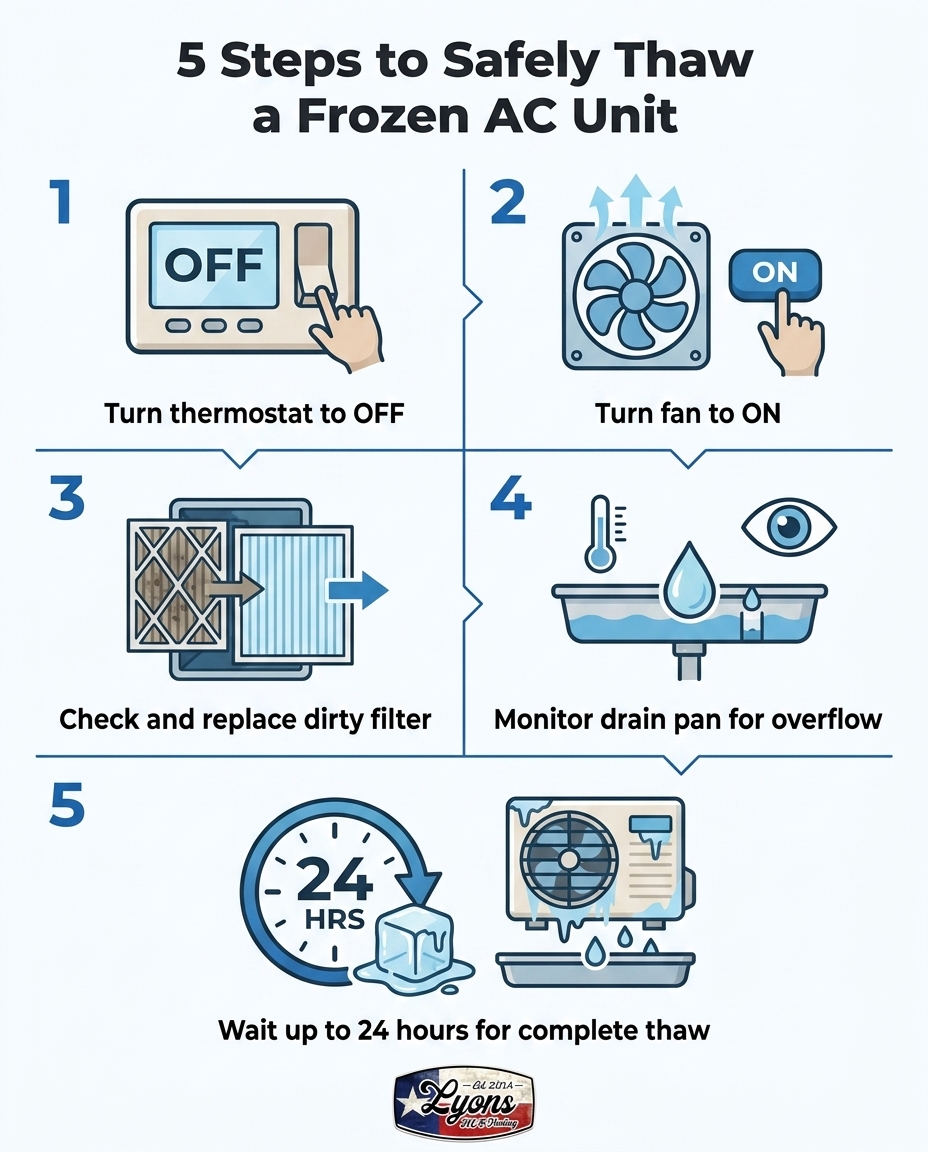
If you discover ice on your indoor unit or the outdoor copper lines, you must take immediate action to protect the equipment. Do not wait for a technician to arrive before starting the thawing process; an HVAC professional cannot properly diagnose a system while it is buried under a block of ice. Follow these exact steps to safely thaw the equipment in the Lake Livingston area:
1. Step 1: Turn the thermostat from "COOL" to "OFF" immediately. This is the most critical step. Shutting off the cooling cycle stops the outdoor compressor from running, which halts the flow of cold refrigerant and prevents permanent, catastrophic damage to the compressor.
2. Step 2: Switch the fan setting from "AUTO" to "ON". By forcing the indoor blower fan to run continuously, you are actively circulating the warm ambient air from your house over the frozen indoor coil. This warm air acts as a safe, natural heat source to melt the ice.
3. Step 3: Check and replace the air filter. Pull out your current air filter and hold it up to a light. If you cannot see light passing through it, it is clogged and must be thrown away. Install a brand-new, clean filter to ensure maximum airflow once the system is restored.
4. Step 4: Monitor the condensate drain pan. A completely frozen coil holds a massive amount of water. As it melts rapidly, the drain pan can easily overflow if the drain line is sluggish. Keep a close eye on the unit and have towels or a wet/dry vacuum ready to prevent water damage to your ceilings or floors.
5. Step 5: Wait up to 24 hours for a complete thaw. Do not rush the process. Depending on the severity of the ice block, it can take anywhere from 12 to 24 hours for the core of the coil to completely defrost. Do not attempt to run the system on "COOL" again until you are absolutely certain all the ice is gone.
Dangerous Thawing Myths You Must Avoid
When the house is sweltering during July peak heat, the urge to speed up the thawing process is strong. However, resorting to ill-advised DIY methods usually results in extensive, easily avoidable damage. Patience is the only safe way to thaw the equipment.
Never chip away at the ice with a sharp object. It is tempting to grab a kitchen knife, an ice pick, or a screwdriver to break off chunks of ice from the coil. The evaporator coil is made of highly pressurized, paper-thin aluminum or copper tubing. Even a slight nick from a tool will puncture the metal, instantly releasing all the refrigerant into the atmosphere. A punctured coil usually means replacing the entire indoor unit.
Do not pour hot water over the frozen coils. Boiling or hot water causes rapid thermal shock. The extreme temperature difference can instantly crack the delicate metal components of the coil and warp the surrounding housing. Additionally, the massive influx of water will immediately overflow the drain pan and flood your home.
Avoid using hair dryers or heat guns. While blowing hot air might seem similar to using the system's fan, heat guns and hair dryers operate at temperatures high enough to melt the plastic drip pans, singe the internal wiring, and warp the system components. Relying solely on the ambient room temperature circulated by your HVAC blower fan is the only approved, safe method.
Long-Term Solutions for Lakeside HVAC Resilience
Surviving the hottest months without interruption requires a proactive strategy. Properties situated near large bodies of water face drastically different environmental pressures than inland homes. Because the Lake Livingston area deals with such intense, heavy moisture loads, standard maintenance schedules often fall short.
To build genuine HVAC resilience, lakeside properties require much more frequent filter changes. While an inland home might get away with changing a filter every 90 days, lakeside homes should inspect and replace filters every 30 days during the summer. Furthermore, professional coil cleaning is absolutely vital. Microscopic dirt traps moisture against the metal, and only professional-grade chemical cleaners can strip that sludge away without damaging the fins.
The Value of Local Expertise
Generic troubleshooting advice rarely accounts for microclimates. Working with our team at Lyons AC & Heating for dedicated HVAC services in Livingston means you are partnering with local microclimate experts who understand the specific maintenance frequency required for lakeside properties in East Texas. We know exactly how the local humidity interacts with your equipment, allowing us to implement a tailored maintenance approach that stops freeze-ups before they ever start.
Restore Your Cooling Safely and Quickly
Discovering an iced-over system is stressful, but understanding why AC units near Lake Livingston freeze up in July (and how to thaw them) puts you back in control. While turning off the compressor and running the fan to thaw the unit is a critical first step, remember that a frozen coil is a symptom of a larger problem, not the root cause. Identifying whether the issue is a clogged filter, a failing blower motor, or a hidden refrigerant leak is essential to prevent the ice from returning.
Do not let a frozen system leave you stranded in the heat. Reach out to local experts who understand the unique environmental stressors placed on your equipment. Schedule a professional inspection today to ensure your system is fully thawed, properly diagnosed, and ready to handle the rest of the extreme summer weather efficiently and safely.
Frequently Asked Questions
How long does it take for an AC unit to unfreeze?
It typically takes anywhere from 12 to 24 hours for a completely frozen AC unit to unfreeze naturally. The exact time depends on the ambient temperature inside your home, the thickness of the ice buildup, and whether you leave the system fan running. Never try to rush this process with heat tools, as you risk causing severe damage to the equipment. Simply leave the thermostat set to 'OFF' and the fan set to 'ON' until the coils are completely bare.
Should I turn my AC off if it freezes?
Yes, you must turn the cooling cycle off immediately the moment you notice ice. Continuing to run a frozen air conditioner forces the outdoor compressor to pump refrigerant against a solid blockage, which can easily cause the compressor to burn out. Switch the thermostat from 'COOL' to 'OFF' to protect the most expensive component of your system while the ice melts.
Can I pour warm water on a frozen AC coil?
No, you should never pour warm or hot water over a frozen evaporator coil. The sudden, drastic change in temperature causes thermal shock, which can instantly crack the delicate metal tubing and cause a massive refrigerant leak. Furthermore, dumping water into the unit will almost certainly overwhelm the condensate drain pan, leading to severe water damage in your home.
Why does my AC freeze up when it's hot outside?
Air conditioners freeze during hot weather because high temperatures force the system to run continuously, while high humidity creates a massive amount of condensation on the cold evaporator coil. If airflow is restricted by a dirty filter or blocked vents, the warm air needed to keep the coil above freezing cannot reach it. The temperature of the coil drops, and the heavy condensation instantly turns into a solid block of ice.
Will a frozen AC unit fix itself if I just leave it alone?
No, a frozen air conditioner will not fix itself. While the ice will eventually melt if the system is turned off, the root cause of the freezing—such as a clogged air filter, low refrigerant, or a broken blower motor—will still be present. If you turn the system back on without addressing the underlying issue, the unit will simply freeze up again within a matter of hours.
How do I know if my AC is frozen if I can't see the indoor coil?
Even if the indoor coil is hidden inside the ductwork, there are several clear signs that your system is frozen. You will likely notice weak, warm airflow coming from your supply vents while the system is running. Additionally, you can check the outdoor unit; if you see thick white ice building up on the larger copper refrigerant pipe connecting to the compressor, the indoor coil is almost certainly frozen solid as well.
Customer Testimonials
Our customers consistently praise our exceptional service and attention to detail, making us a trusted choice for all your HVAC needs.
Service Areas
Our service areas cover a wide range of locations, ensuring that we can meet your needs wherever you are. We are committed to providing top-notch service in every region we operate.