

The Real Reason Your AC Capacitor Fails During Triple-Digit Heatwaves
Extreme temperatures don't just cause generic wear and tear—they specifically target your AC capacitor. Understand the physics behind this thermal breakdown and when to replace it.

When the Heat Breaks Your AC: The Hidden Threat to Your Condenser
Your air conditioner is running nonstop, but the house still feels warm, and a strange humming sound is coming from the outdoor unit. The real reason your AC capacitor fails during triple-digit heatwaves comes down to a specific mechanical breakdown, not just bad luck. When outdoor temperatures soar and your cooling system suddenly quits on the hottest day of the year, our technicians at Lyons AC & Heating find that the most common culprit is a small, cylindrical component sitting inside your condenser unit.
Many homeowners assume a sudden breakdown means the entire air conditioner has died. In reality, the extreme thermal load of triple-digit temperatures specifically targets your AC capacitor. This isn't just generic wear and tear. It is a precise physical failure driven by relentless heat and electrical stress. Understanding the physical limits of this crucial component helps you make informed decisions about your air conditioning services and proactive replacement before you lose cooling entirely.
The Heavy Lifter: What an AC Capacitor Actually Does
To understand why the heat destroys this part, you first need to know what it does. You can think of an AC capacitor as a high-voltage, short-burst battery. Your air conditioner's compressor and fan motors require a massive jolt of electricity to start spinning—often three to five times more power than your home's wiring can provide instantly on its own. The capacitor stores electrical energy and releases it on demand.
1. Storing the Charge: While the system is idle, the capacitor pulls electricity from your home's grid and stores it, acting like a reservoir of power waiting for the thermostat's signal.
2. Delivering the Jolt: When your AC clicks on, the capacitor releases a powerful surge of electricity (known as Locked Rotor Amps) to jump-start the heavy compressor and fan motors.
3. Maintaining the Current: Once the motors are running, the capacitor continues to provide a smooth, steady supply of power to keep them operating efficiently.
This continuous electrical delivery generates its own internal heat, even before factoring in the weather outside. When July peak summer conditions arrive, that internal heat becomes a serious liability.
The Difference Between Start and Run Capacitors
Most residential cooling systems use a dual capacitor setup, which combines two distinct functions into one metal casing.
• Start capacitors provide the massive initial torque required to get the heavy compressor motor spinning from a dead stop.
• Run capacitors maintain the precise electrical current needed to keep the motor operating smoothly and efficiently.
• The shared burden: Both functions subject the component to intense electrical and thermal stress during every single cooling cycle.
The Physics of Overheating: Internal Resistance vs. Ambient Heat
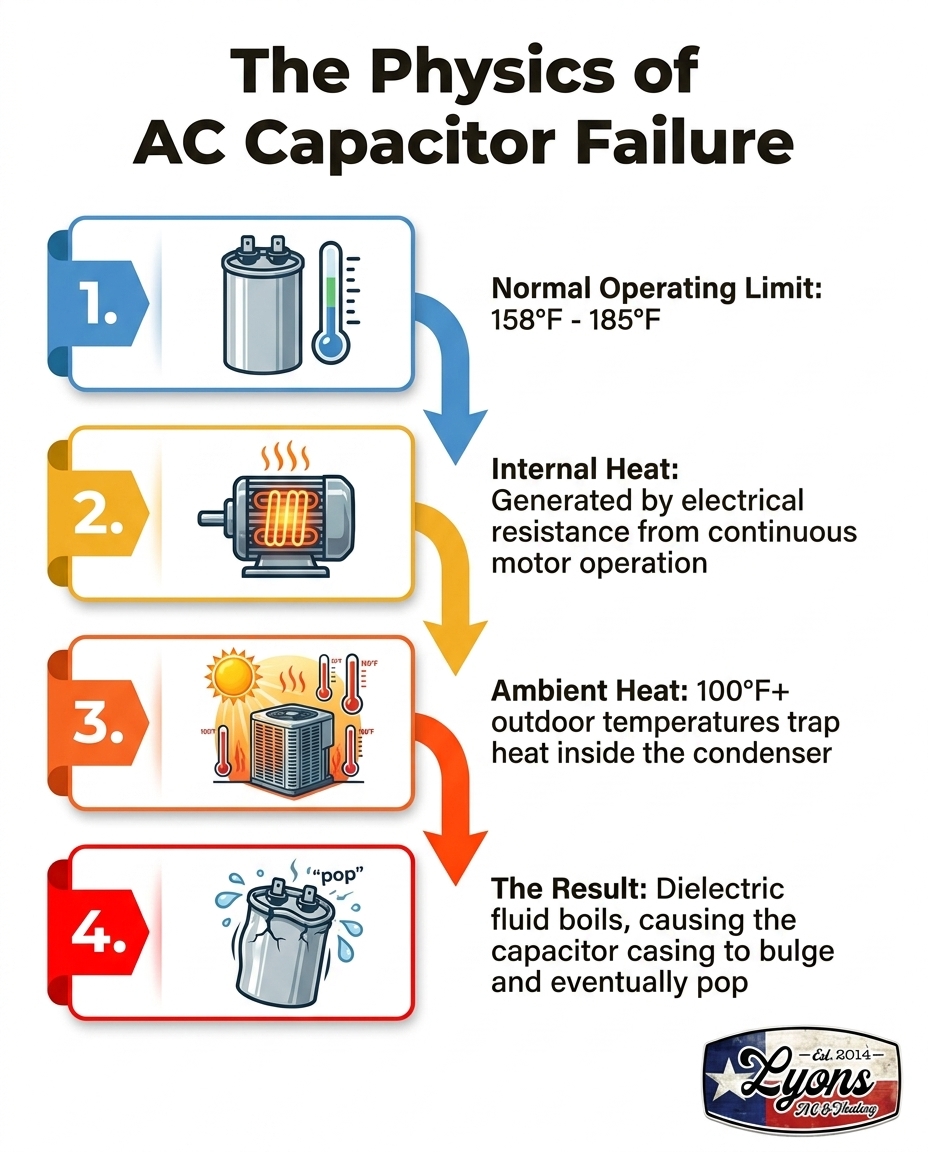
The Problem: Every electrical component has a thermal limit. Standard HVAC run capacitors are typically engineered and rated by manufacturers for internal operating temperatures up to 158°F (70°C) or 185°F (85°C). When the component gets hotter than its rating, it begins to break down.
The Cause: The heat attacking your capacitor comes from two different directions. First, there is internal electrical resistance. As high-voltage electricity flows through the capacitor to keep your motors running, it naturally generates internal heat. Second, there is ambient outdoor heat. When you are dealing with triple-digit temperatures, the outdoor air surrounding the condenser unit is incredibly hot. The metal cabinet of the condenser absorbs the sun's rays, turning the inside of the unit into an oven. Because the ambient air is already so hot, the condenser cannot effectively dissipate the capacitor's internal electrical heat.
The Solution: The combination of internal electrical load and external ambient heat pushes the component past its engineered thermal limit. Recognizing this compounding effect is the first step in understanding why proactive inspections are so valuable. By checking the electrical capacitance (measured in microfarads) before the hottest months arrive, technicians can identify parts that are already running hot and struggling to maintain their charge.
Dielectric Fluid Breakdown: What Happens Inside a Failing Capacitor
The failure of a capacitor is a physical reality, not just a sales tactic. Inside the metal casing of the capacitor, thin layers of metallic film are separated by an insulating liquid called dielectric fluid. This fluid prevents the electrical charges from jumping across the internal components and causing a short circuit.
When the combined internal and external heat exceeds the manufacturer's thermal limit, this dielectric fluid begins to literally boil. As the liquid boils, it degrades and outgasses, creating pressure inside the sealed metal canister. Because the canister is completely sealed, the expanding gas has nowhere to go. This causes the top of the metal casing to physically swell and bulge outward.
In the final stage of failure, the pressure becomes too great. The capacitor is designed with a fail-safe mechanism: as the top bulges far enough, it intentionally breaks the internal electrical connection. The capacitor "pops" or vents, severing the circuit entirely to prevent a catastrophic electrical fire. Once this happens, your AC motors lose their power supply, and your cooling stops immediately.
Why Visual Inspections Matter
A bulging top on a capacitor is a definitive, undeniable sign of dielectric fluid expansion. When our Lyons AC & Heating technicians open up a struggling condenser, this is exactly what we look for. The top of a healthy capacitor should be perfectly flat. Once a capacitor begins to swell into a dome shape, its failure is imminent and irreversible. You cannot repair a bulging capacitor; it must be replaced before it completely severs the connection.
Recognizing the Warning Signs Before Total Failure
Because dielectric fluid breakdown happens over time as heat accumulates, your system will often give you subtle warning signs before it completely shuts down. Catching these symptoms early can save you from a miserable afternoon without air conditioning.
• A distinct clicking or humming sound: If you hear a buzzing or humming noise coming from the outdoor condenser unit, but the fan isn't spinning, the capacitor is likely trying—and failing—to send the required voltage to the motor.
• Stationary fan blades: If your thermostat says the system is "on" but the outdoor fan blades are completely still, the run capacitor has likely failed. (Understanding why your AC fan stops working is critical, as the fan is responsible for exhausting heat from the system).
• Hard starts and struggling: If your air conditioner stutters, dims the house lights significantly, or takes much longer than usual to turn on, the capacitor is losing its ability to store a full charge.
• Rapid short-cycling: If the unit turns on and off in very short bursts, a weak capacitor may be overheating and causing the compressor to shut down prematurely.
The danger of waiting: Letting a system run with a dead or dying capacitor is incredibly dangerous for your equipment. Without the capacitor's help, the compressor motor will try to pull massive amounts of electricity directly from your home's grid. This causes the compressor to overheat rapidly, which can lead to a burnt-out compressor—a repair that is vastly more expensive than a simple capacitor replacement.
The Compounding Toll of Continuous Operation
The weather specific to your region plays a massive role in how long these electrical components survive. During milder spring or autumn weather, your air conditioner cycles on, cools the house, and then cycles off. These off-cycles give the internal electrical components time to cool down and shed their internal heat.
However, during extreme heatwaves, outdoor condenser units run almost continuously just to maintain basic indoor comfort. As our team sees every year in the Livingston, TX service area, summer weather patterns frequently feature sustained, multi-day stretches of triple-digit temperatures. This traps heat in the outdoor unit and removes the system's ability to cool down.
This relentless, continuous operation creates a sustained thermal load on the capacitor. The dielectric fluid never gets a chance to cool back down to a safe temperature. Day after day, the heat compounds, accelerating the breakdown of the insulating oil. This continuous operation is exactly why our dispatchers at Lyons AC & Heating take so many emergency calls for blown capacitors during severe regional heatwaves.
Validating the Recommendation: Proactive Replacement vs. Emergency Breakdowns
We understand that homeowners are often naturally skeptical when a technician suggests replacing a part that hasn't fully broken yet. If the air conditioner is still producing cold air, why spend the money to replace the capacitor? The answer lies in the physics of dielectric fluid breakdown. Once a capacitor shows signs of swelling or tests below its required microfarad rating, it is mathematically a ticking clock. It is no longer a question of if it will fail, but when.
When weighing your options for comprehensive HVAC services, comparing a proactive replacement against an emergency breakdown makes the choice clear.
• Timing — Proactive Replacement: Scheduled at your convenience during a routine tune-up. — Emergency Breakdown: Happens suddenly, usually on the hottest day of July peak summer.
• Comfort Impact — Proactive Replacement: Zero disruption to your home's cooling. — Emergency Breakdown: Hours spent in a rapidly heating house waiting for repairs.
• System Safety — Proactive Replacement: Protects the compressor from voltage strain and overheating. — Emergency Breakdown: Forces the compressor to run hot, risking fatal motor damage.
• Cost Efficiency — Proactive Replacement: Standard part replacement cost during a normal visit. — Emergency Breakdown: Often involves after-hours or emergency dispatch fees.
While fast, reliable emergency response is always available for sudden breakdowns, preventing the emergency entirely is always the safer, more comfortable choice for your home. In our experience, replacing a weakened capacitor is a small step that protects the much more expensive compressor from fatal damage.
Frequently Asked Questions About AC Capacitors and Heat
Why do AC capacitors go bad in the summer?
AC capacitors go bad in the summer because the extreme outdoor heat prevents the component from shedding its internal electrical heat. The combination of ambient triple-digit temperatures and the continuous operation of the AC unit pushes the capacitor past its thermal limit. This causes the internal components to overheat and degrade rapidly.
How hot is too hot for an AC capacitor?
Most standard HVAC run capacitors are engineered to operate safely at internal temperatures up to 158°F (70°C) or 185°F (85°C). When the outdoor ambient air exceeds 100 degrees, the added heat from electrical resistance easily pushes the internal temperature of the capacitor beyond these safe operating limits, leading to mechanical failure.
What happens to the dielectric fluid in a capacitor?
When a capacitor overheats, the dielectric fluid inside begins to boil and turn into a gas. Because the metal casing is completely sealed, this outgassing creates intense internal pressure. This pressure forces the top of the metal canister to bulge outward, eventually causing the internal wiring connection to break.
Can extreme heat ruin a capacitor?
Yes, extreme heat is the primary cause of premature capacitor failure. Sustained high temperatures break down the insulating dielectric fluid inside the component. Without a chance to cool off during continuous summer operation, the heat physically destroys the capacitor's ability to hold and deliver an electrical charge.
What happens when an AC capacitor fails?
When an AC capacitor fails, it stops delivering the voltage required to start or run your condenser motors. You will typically hear a humming or clicking sound from the outdoor unit, but the fan blades will not spin, and the compressor will not turn on. Your system will immediately stop producing cold air.
How long does an AC capacitor usually last in extreme climates?
In extreme climates with sustained triple-digit temperatures, an AC capacitor may only last 3 to 5 years, compared to 10 to 15 years in milder regions. The relentless thermal load and continuous lack of off-cycles significantly shorten the lifespan of the dielectric fluid and the component as a whole.
Protect Your Cooling System Before the Next Heatwave
Extreme thermal load is a mechanical reality, not just bad luck. When July peak summer heatwaves arrive, the physics of internal resistance and ambient heat create a hostile environment for your air conditioner's most critical electrical components. Understanding how dielectric fluid breaks down empowers you to take action before you are left sweating in a hot house.
The best way to protect your system is to have your capacitors professionally tested for electrical capacitance and visually inspected for bulging before the severe heat sets in. By exploring a routine AC maintenance plan with Lyons AC & Heating, you can ensure your cooling system is prepared for peak summer stress, keeping your home comfortable and your equipment safe all season long.
Customer Testimonials
Our customers consistently praise our exceptional service and attention to detail, making us a trusted choice for all your HVAC needs.
Service Areas
Our service areas cover a wide range of locations, ensuring that we can meet your needs wherever you are. We are committed to providing top-notch service in every region we operate.