
How Our Dispatch Team Prioritizes Emergency Cooling Calls in Polk County
When severe summer heat strikes, a broken air conditioner becomes a serious health risk. We pull back the curtain on how we triage repair requests to protect our most vulnerable neighbors.

When the Heat Spikes: Managing the Rush of Summer Breakdowns
When your air conditioner suddenly stops blowing cold air and the indoor thermostat creeps past 85 degrees, understanding exactly how our dispatch team prioritizes emergency cooling calls in Polk County becomes incredibly important. A broken cooling system during a severe weather event is a stressful, immediate problem that disrupts your entire day. You pick up the phone hoping a technician can arrive within the hour, but across the region, dozens of other homeowners are experiencing the exact same crisis. We know how miserable and alarming it feels to be trapped in a rapidly heating house, and our dispatch team wants nothing more than to fix every single unit the moment a call comes in. However, when extreme temperatures create a massive surge in breakdowns, we cannot treat every call as simply first-come, first-served. We must make critical triage decisions to ensure our community stays safe.
If you need immediate assistance or want to learn more about our comprehensive HVAC services, our team is ready to help you navigate the heat.
The Shift from Routine to Emergency Operations
On a mild spring afternoon, scheduling is relatively straightforward. We book appointments sequentially, and technicians move from one routine service call to the next. But when a severe weather event hits, that predictable schedule shatters. The sheer volume of incoming requests forces our office into emergency operations mode. During these spikes, our dispatchers transition from standard scheduling to active triage. They must rapidly assess the severity of each situation over the phone, weighing technical failures against human safety risks. This operational shift is essential because extreme heat transforms a mechanical inconvenience into a genuine health hazard, demanding a highly structured response to protect the most vulnerable members of our community.
The Reality of a Full Dispatch Board in Peak Summer
When a July peak summer heatwave settles over East Texas, our internal dispatch board transforms dramatically within a matter of hours. At 7:00 AM, the schedule often looks entirely manageable. By 10:00 AM, as the morning sun intensifies and struggling cooling systems finally give out under the heavy load, the board is completely full. We suddenly face a stark mathematical impossibility: we have a finite number of highly trained technicians and an overwhelming number of homes losing their cooling simultaneously.
If you are wondering what to do if your HVAC stops working at night, you already understand the panic that sets in when the vents go quiet. Now, multiply that panic by fifty homes calling our office at the exact same time. This immense volume requires our dispatchers to act as air traffic controllers for HVAC trucks.
A Glimpse at the Dispatch Screen
To understand the pressure our team navigates, it helps to see how quickly the situation escalates. Here is a typical pattern we see on the dispatch board during a severe weather event:
• 7:00 AM — Board Status: Normal capacity. Mostly pre-scheduled maintenance and minor repairs. — Dispatch Action Required: Standard sequential routing based on geographic zones.
• 10:00 AM — Board Status: Board fills rapidly. Overnight failures are reported as homes begin to heat up. — Dispatch Action Required: Begin filtering calls. Move routine maintenance to later dates to free up trucks.
• 2:00 PM — Board Status: Board overflows. Systems running continuously since noon begin to fail. — Dispatch Action Required: Strict triage protocol activated. Only severe emergencies receive immediate dispatch.
• 5:00 PM — Board Status: Critical backlog. Technicians working overtime to clear high-priority calls. — Dispatch Action Required: Assess next-day schedule. Communicate expected delays to lower-priority callers.
Our dispatchers are the unsung heroes of the summer season. They stare at screens filled with flashing alerts, remaining calm while gathering the right facts from stressed homeowners. They build a complex puzzle where the pieces are constantly shifting. Because we cannot physically be everywhere at once, we rely on a strict, safety-first prioritization protocol to determine who gets the next available truck.
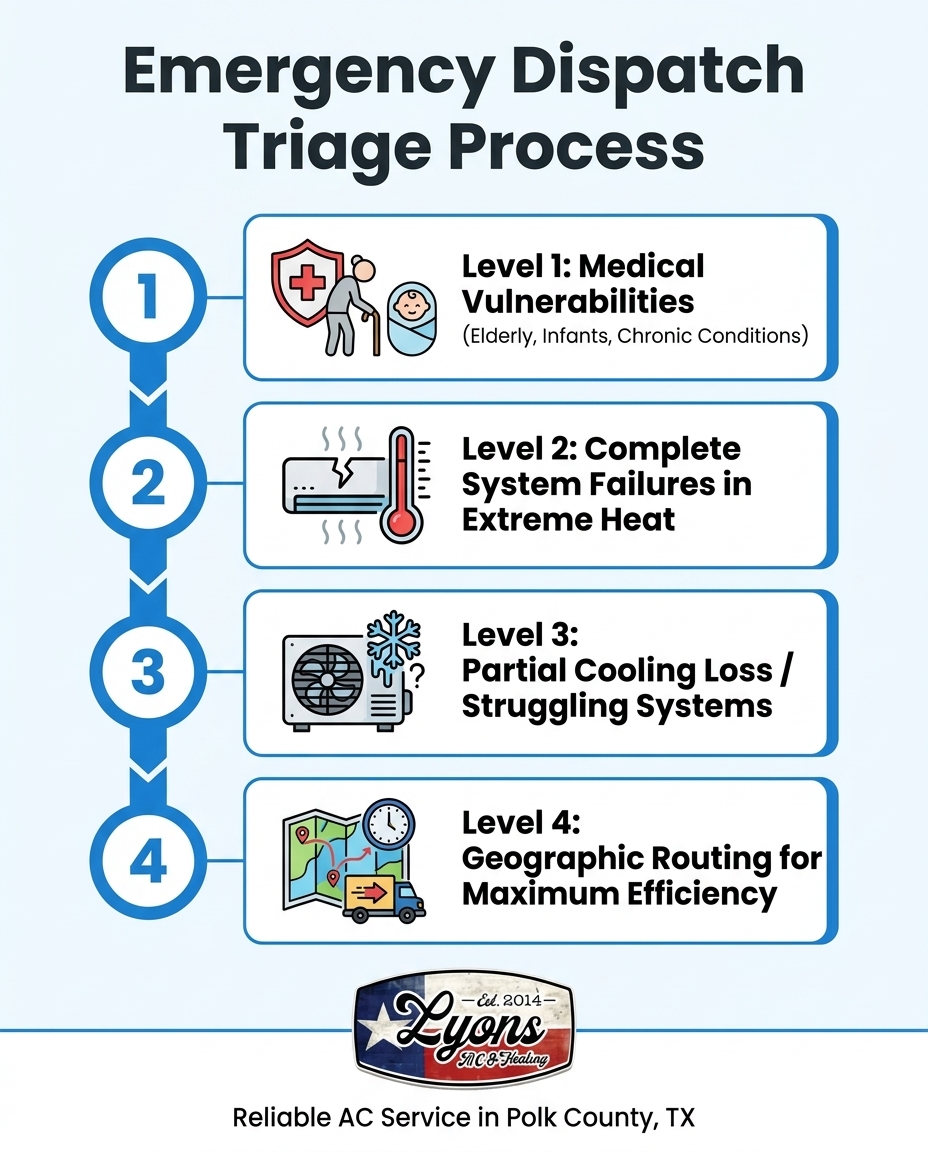
Triage Level 1: Medical Vulnerabilities and Extreme Safety Risks
We do not view our business as merely a mechanical repair company; we view it as a community health partner. This means our dispatching methodology treats HVAC repair as a critical health service. When we look at an overflowing dispatch board, human safety serves as the absolute baseline for all routing decisions. The highest priority category—Triage Level 1—is reserved exclusively for homes where extreme indoor temperatures pose an immediate medical threat.
These critical emergencies bypass standard wait times entirely. If a healthy family in their thirties has to wait a few extra hours so we can restore cooling for an eighty-year-old resident on oxygen across our Livingston service area, that is a trade-off we make every single time. Extreme heat is a severe health hazard, and we actively prioritize the following vulnerable groups:
• Elderly residents: Older adults have a much harder time regulating their body temperature, making them highly susceptible to heatstroke and heat exhaustion in a stifling house.
• Infants and newborns: Babies cannot sweat effectively enough to cool themselves down, making rapid temperature spikes incredibly dangerous for them.
• Individuals with chronic medical conditions: Anyone relying on oxygen, recovering from surgery, or managing severe respiratory or cardiovascular issues requires a stable, climate-controlled environment to remain safe.
Our dispatch team is trained to listen for these critical details. We ask specific questions to identify these risks upfront, ensuring that our most vulnerable neighbors are never left waiting in dangerous conditions simply because they called ten minutes later than someone else.
Triage Level 2: Complete System Failures vs. Partial Cooling Loss
Once we secure the safety of our medically vulnerable neighbors, our dispatch team evaluates the technical severity of the remaining breakdowns. When life-safety factors are equal among callers, the physical state of the equipment dictates the urgency. We must distinguish between a system that is completely dead and one that is simply struggling to keep up with the afternoon heat.
With intense Texas heatwaves bringing heavy humidity and air temperatures well over 100 degrees, a home experiencing a complete system failure will see indoor temperatures exceed 90 degrees within just a few hours. A complete failure means the blower motor is dead, the compressor refuses to turn on, or the system has lost power entirely. Absolutely zero air is moving through the vents. Because the indoor environment degrades so rapidly, these situations require urgent air conditioning repair before the home becomes uninhabitable.
Assessing the Symptoms Over the Phone
Contrast a complete failure with a partial cooling loss. In a partial loss scenario, the system is running constantly, and air is flowing from the vents, but the house will only cool down to 78 degrees instead of the desired 72 degrees. While this is certainly uncomfortable and frustrating, the home remains habitable, and the temperature is relatively stable. Our dispatchers carefully assess these technical symptoms over the phone to categorize the breakdown accurately.
• Complete Failure — Typical Symptoms: Blank thermostat, silent outdoor unit, zero airflow from indoor vents, rapid indoor heat rise. — Triage Priority Level: High Priority (Dispatched immediately after medical emergencies).
• Partial Cooling Loss — Typical Symptoms: System runs constantly, weak airflow, blowing lukewarm air, home stays around 78-80 degrees. — Triage Priority Level: Medium Priority (Dispatched once complete failures are resolved).
• Intermittent Issues — Typical Symptoms: Strange noises on startup, occasional short-cycling, minor water drips near the indoor unit. — Triage Priority Level: Standard Priority (Scheduled for the next available standard opening).
By routing technicians to address complete failures before partial losses, we prevent homes from reaching dangerous temperature thresholds, maximizing the overall comfort and safety of the community.
What to Tell Our Dispatchers When You Call
When you call our office during a summer heatwave in Livingston and greater Polk County, the information you provide directly impacts how quickly we can route a technician to your door. Vague details slow down the triage process and make it harder for our team to assess the true urgency of your situation. Simply saying "my AC is broken" does not give us the context we need to prioritize your home correctly. To help us help you, here is exactly what you should tell our dispatchers:
1. State any medical vulnerabilities immediately: Start the conversation by letting us know if there are elderly individuals, newborns, or residents with chronic health conditions living in the home. This immediately flags your call for Level 1 triage.
2. Provide the exact indoor temperature reading: Look at your thermostat and tell the dispatcher the current indoor temperature, not just what the system is set to. A home sitting at 88 degrees requires a faster response than a home sitting at 77 degrees.
3. Describe the specific technical symptoms: Be as descriptive as possible. Is the system blowing warm air? Is it making a loud grinding noise? Is the outdoor unit completely silent? Specific symptoms help us diagnose the severity and ensure the technician brings the right parts.
4. Note the timeline of the failure: Tell us when you first noticed the problem. Did the system shut off suddenly an hour ago, or has it been slowly losing ground over the past three days?
Providing accurate, detailed information helps our dispatch board route the right truck with the correct replacement components much faster, saving valuable time and getting your home cooled down sooner.
Behind the Scenes: Routing Trucks for Maximum Efficiency
After we filter incoming calls through the critical lenses of medical vulnerability and complete system failure, we turn our attention to geographic logistics. Polk County covers a large area, and drive time is the biggest enemy of a busy dispatch board. If we send a technician back and forth across the county randomly, they will spend half their day staring at the highway instead of fixing air conditioners.
Once the safety-critical calls are handled, our dispatchers group the remaining appointments by geographic proximity. If we have three partial-cooling calls on the north side of town, we will assign them all to the same technician. Reducing technician drive time by just one hour means we can fit one or two more emergency calls into a single day. That translates directly to more families getting their cooling restored before the sun goes down.
The Role of Constant Communication
Geographic routing requires constant, real-time communication between the office and the field. Our dispatchers monitor the progress of every truck. If a technician finishes a repair early, the dispatcher can instantly route them to a nearby home that just called in. Conversely, if a Level 1 medical emergency suddenly arises, the dispatcher must reroute the closest technician on the fly, pulling them off a lower-priority route to handle the immediate crisis. This dynamic balancing act ensures maximum efficiency while maintaining our strict safety standards.
Preventing the Emergency: The Role of Proactive Care
The absolute best way to handle an emergency dispatch scenario is to avoid landing on the triage board in the first place. While some component failures are unpredictable, a significant portion of the peak-season breakdowns we respond to are entirely preventable with early intervention. When a cooling system is pushed to its absolute limit during a severe heatwave, any underlying weakness—a failing capacitor, a clogged filter, or low refrigerant—will quickly trigger a complete operational failure.
Pre-season checks allow our technicians to identify and resolve these stressed components long before the extreme heat arrives. By addressing minor noises, weak airflow, or slight cooling drops early, you prevent the system from locking up when you need it most. Investing in routine AC maintenance keeps your equipment running smoothly and keeps your family out of the emergency queue.
Early warning signs to address before a heatwave hits:
• Short cycling: The system turns on and off rapidly without fully cooling the home.
• Unusual noises: Grinding, squealing, or rattling sounds coming from the outdoor cabinet or indoor blower.
• Weak airflow: Barely any air pushing through the supply vents, indicating a blower issue or frozen coil.
• Rising energy bills: A sudden spike in electrical costs suggests the system is working much harder than it should to maintain the temperature.
Frequently Asked Questions About AC Emergencies
What is considered an AC emergency?
An AC emergency is generally defined as a complete loss of cooling during extreme temperature conditions, especially if vulnerable individuals are present in the home. When indoor temperatures rise rapidly and create a health hazard, the situation escalates from a standard repair to an emergency dispatch. Minor issues like strange noises or slightly warmer air are concerning, but they do not typically constitute a life-safety emergency.
How do HVAC companies prioritize emergency calls?
HVAC companies prioritize emergency calls by focusing on human safety first. Dispatchers place homes with medical needs, elderly residents, or infants at the very front of the line. After securing those vulnerable locations, companies prioritize complete system failures over partial cooling losses, and finally use geographic routing to reach the remaining homes as efficiently as possible.
What should I tell an HVAC dispatcher when my AC breaks?
You should immediately tell an HVAC dispatcher if anyone in the home has a medical vulnerability, is elderly, or is an infant. Next, provide the current indoor temperature reading from your thermostat. Finally, describe specific symptoms—such as whether the unit is completely silent, blowing warm air, or making unusual noises—so the team can assess the technical severity of the breakdown.
At what indoor temperature is no AC an emergency?
Generally, when indoor temperatures exceed 85 to 90 degrees, the lack of air conditioning becomes a severe risk. However, this threshold is significantly lower for the elderly, infants, or individuals with respiratory conditions, who can suffer heat-related illness at much lower temperatures. Always monitor the indoor thermometer closely during a system failure.
How long does it take for emergency AC repair?
Response times vary widely based on total board volume and your specific triage priority level. During a severe heatwave, standard calls may face delays, but emergency dispatch teams aim for same-day resolution for high-risk situations involving complete failures or vulnerable residents. Providing accurate information when you call helps speed up this process.
Dedicated to Keeping Our Community Safe
At the end of a long, sweltering day, our ultimate goal is to ensure our community remains safe, healthy, and comfortable. We know that waiting for a repair is incredibly stressful, especially when the summer heat is relentless. However, we hope this behind-the-scenes look at our dispatch board provides reassurance that every decision we make is rooted in care, efficiency, and human safety. We treat our customers like neighbors, not just numbers in a queue. If your cooling system is struggling to keep up, or if you notice warning signs before the next heatwave hits, please reach out to our team so we can help restore your comfort.
Customer Testimonials
Our customers consistently praise our exceptional service and attention to detail, making us a trusted choice for all your HVAC needs.
Service Areas
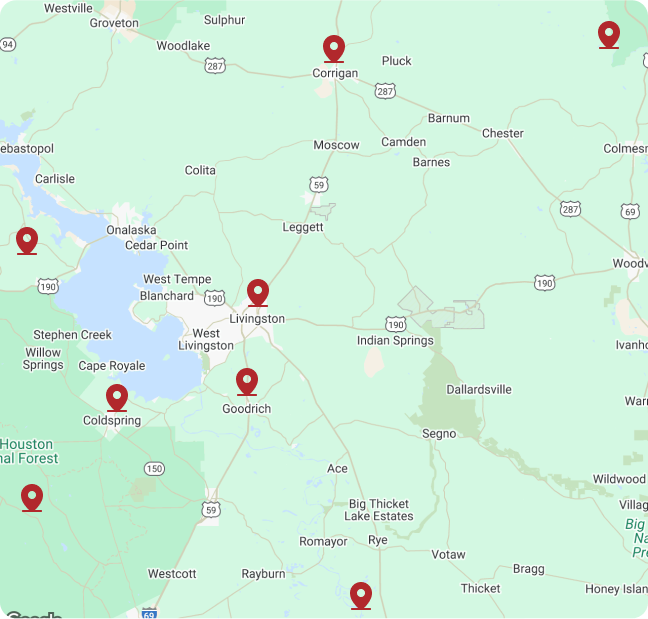
Our service areas cover a wide range of locations, ensuring that we can meet your needs wherever you are. We are committed to providing top-notch service in every region we operate.